
Twenty tons an hour is a production rate, and it changes what kind of decision you are making. The force class is almost the easy part at this point; what decides whether you reach the number is the discharge arrangement, the handling behind it, and whether the site was planned around the flow or around the machine. Across real-world industrial scrap metal shear installations, experience with our 1250 Ton Scrap Metal Shear (Q91-1250) confirms that proper material prep and hydraulic maintenance drive long-term profitability.
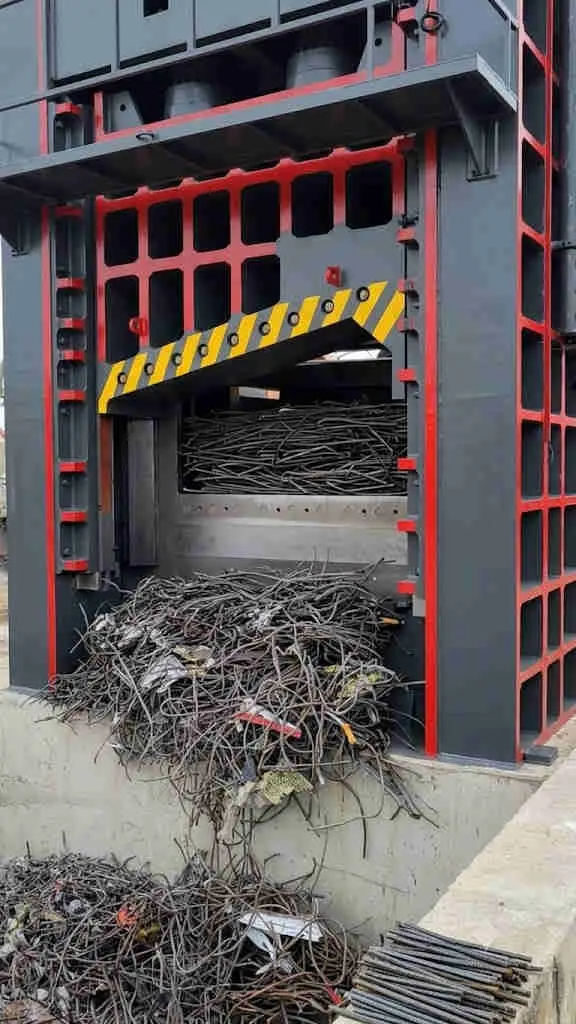
This article covers what 20 t/h demands from a yard, why the handling plan is the real specification, and which class in the gantry shear range carries it honestly. Boundary figures are from published specifications; anything operational is framed as arithmetic or field experience.
What 20 tons per hour adds up to
Twenty tons an hour across eight hours is roughly 160 tons a day, and two shifts approaches 320. Those numbers put you in production-class territory: the Q91-1250 is rated at 160 to 200 tons per day with 120 mm plate as continuous duty and 150 mm occasionally.
The arithmetic is the simple part. At 160 tons a day the machine produces a steady stream of sized material that has to leave the site, and that stream is what most yards underestimate. A truck holds what it holds; if your output arrives faster than your trucks leave, the material banks up and the machine waits.
Why the discharge plan is the real specification
At this rate the discharge zone is a logistics problem with a machine attached. Three arrangements work, and the right one depends on what happens to the material next:
- Direct to truck. Works when your buyer collects on a schedule that matches your output. The risk is the gap between a full bay and the next truck.
- Buffer plus loader. A small accumulation that absorbs the rhythm difference between cutting and hauling. Too small and the machine starves; too large and you have built a second handling job.
- Conveyor to a second stage. Where a baler or shredder sits behind the shear, the handoff gets specified at quotation: drop height, buffer volume and the handling between box and chamber.
Plan it before the order, not after installation. The line design guide covers how the stages get sized against each other.
Sizing the buffer, and the late-truck week
The buffer is sized by method rather than by a brochure figure, because the figure is yours. Watch the discharge zone for the busiest hour of a normal week and count the minutes material spends banked before it leaves. Multiply those minutes by the machine’s delivery rate in tons per minute, and round up for the week a truck is late. A buffer sized for the average hour fills in the busy one; a buffer sized far beyond the busy hour becomes a handling job with its own loader and crew.
The same count separates the causes. A full buffer with trucks leaving on time is a destination problem. A buffer that fills before the truck arrives is a volume problem. A buffer that never fills while the machine still waits is a loading problem upstream.
Two layout points cost little on paper. Keep the feed route and the discharge route apart for the whole loop, because a crossing costs a minute every cycle and at 20 t/h minutes are tons. And plan for the late-truck week: a secondary overflow destination, even a floor pile that clears by Friday, plus a haulage schedule with a stated fallback agreed with your carrier before the machine arrives. Re-run the busy-hour count whenever the material mix or the haulage changes.
What the site has to carry
Three site items decide whether a production machine performs like one, and all three are fixed before the build:
- Foundation. The reaction force of every cut goes into the floor. Drawings go to your contractor the week the order is placed, with anchorage matched to the declared duty rather than to the brochure.
- Power. Motor ratings at this class do not tolerate discovery on delivery day. Voltage, frequency, spare kilowatts and the starting method get confirmed with your electrician in writing before the build.
- Route in. Crate dimensions and weight in hand, the path into the building confirmed with numbers rather than at the port.
In practice, the site work sets the installation timeline more often than the factory does, which is why the site track starts at the order rather than at the ship date.
When 20 t/h points at a different class
If your daily tonnage sits nearer 80 than 160, the 630 Ton Scrap Metal Shear Machine (Q91-630) covers the rate with headroom for less money. If your heaviest routine material runs past 120 mm continuously, or the day genuinely approaches 240, the 1600 Ton Scrap Metal Shear Machine (Q91-1600) at 150 mm continuous is the class the material asks for.
The computation guide converts cycle rate into your shift tonnage, and the range table shows the published bands side by side.
What a production purchase adds to the specification
Below this rate, a quotation is mostly about the machine. At 160 tons a day it is about the machine, the site and the schedule, and three items stop being details. The foundation carries the reaction force of every cut, and the anchorage is specified against the declared duty rather than a generic figure. The power package is agreed with your electrician in writing before the build, because motor ratings at this class do not tolerate discovery on delivery day. And the route in is confirmed with crate dimensions in hand rather than at the port.
The duty declaration matters more here too. A machine quoted for two shifts is a different build from one quoted for three, and the difference is invisible on a price sheet and obvious in year three. The three-shift economics guide covers what the declaration carries, and the downtime accounting guide prices the hours the site plan exists to prevent.
The spares conversation at production scale
A production machine plans its second half at quotation rather than after the first failure. One blade set, the seal kit and the filter stock sit on the shelf before commissioning, sized to the shift pattern. The resupply channel covers the rest, and the commissioning plan walks the crew through each wear-part replacement rather than demonstrating it.
The reason is arithmetic. At 160 tons a day every shift is a shift you cannot afford to lose, and a procedure the crew has performed once is a planned change while a procedure they have only read about is a stop. The specification reading guide covers how the spares depth appears in a quotation, and the inspection guide covers what to check when the machine is not new.
The first month, scheduled around production
Commissioning a production machine is a scheduling exercise rather than an installation one. Week one after arrival is leveling and electrical connection. Week two is test runs on your actual material, with the presets set against it and the crew watching. Week three is your operators running it with training fresh, while our engineer is still on the line or on call.
The maintenance window goes inside that schedule rather than against it, and each wear-part replacement gets walked through with the crew that will perform it. Not demonstrated, performed. At 160 tons a day a procedure the crew has done once is a planned change, and a procedure they have only read about is a stop. The first month is also when the blade log starts and the handover becomes formal, and both habits are cheaper to form with an engineer on site than to retrofit from a manual.
What the site track looks like on a calendar
The factory track is fixed: order, build, load test, documentation, packing, shipping, customs. The site track is yours, and it runs in parallel from the day the order is placed. Foundation drawings issued at order. The pour and the cure, which take their own time regardless of what the factory schedule says. The electrical scope with your electrician. The route measured and cleared.
The two tracks meet at installation, and the meeting date is set by whichever finishes last. Write both schedules at the order and the date becomes a plan rather than a hope. The import sequence guide walks the eleven steps, and the 2000-ton high-volume shear planning guide covers the payment structure at this scale.
Buyer FAQ
What daily tonnage does 20 tons per hour mean?
Roughly 160 tons on one eight-hour shift and about 320 on two, assuming feed and discharge keep up. The published band of the Q91-1250, 160 to 200 tons per day, sits right at that single-shift figure.
Which class covers 20 t/h?
The Q91-1250 covers it within its published band. The 630 class is worth pricing if your real day is nearer 80 tons; the 1600 if it approaches 240. The honest daily tonnage decides, not the hourly rate on the inquiry form.
Why does the discharge matter more at this rate?
Because the machine produces faster than any single truck can haul. The pile between the box and the truck becomes the constraint unless a buffer or a second stage is planned into the layout at quotation.
What do you need to quote a production machine?
Material list with the three heaviest pieces, honest daily tonnage, shift pattern, discharge plan, and site facts: power, foundation conditions and the route in. The written quotation comes back within two business days with the class and the configuration your numbers support, restated against the duty declaration you gave us.
What is the difference between the 1250 and the 1600 at this rate?
The 1250 carries 120 mm continuous plate and a 160 to 200 ton per day band. The 1600 carries 150 mm continuous and 200 to 240 tons. If your heavy tail runs past 120 mm as routine, or your two-shift day approaches 240, the 1600 is the class the material asks for. Below those numbers the 1250 does the job for less purchase price and less installed power. A final word on sequencing, because it decides more production purchases than the machine choice does. Order the site work with the machine, not after it. The foundation drawings go to your contractor the week the order is placed, the electrical scope is confirmed before the build, and the route in is measured while the crate is still on the drawing board. The machine that arrives into a finished yard commissions in week one. The machine that arrives into a construction project waits, and the waiting is the most common avoidable cost in a production import.
Need help sizing cutting force, blade length, and hydraulic power for your throughput? Compare full machine parameters on our 1250 Ton Scrap Metal Shear (Q91-1250) page, review our Q91 & NS scrap shear hub engineering hub, or contact HUAXIN’s Tangshan engineering team with your feedstock photos and target daily tonnage.
One Comment