
Ten tons an hour is the rate where the machine stops being the constraint. The shear can turn out that much on paper; whether your yard does depends almost entirely on how material reaches the box and how fast the output leaves it. Buyers who shop this rate by tonnage alone end up with a capable machine in a yard that cannot feed it. For yards evaluating heavy-duty scrap shear setups, operating benchmarks from our 630 Ton Scrap Metal Shear (Q91-630) show how hydraulic pressure stability and feeding habits directly shape cost per ton.
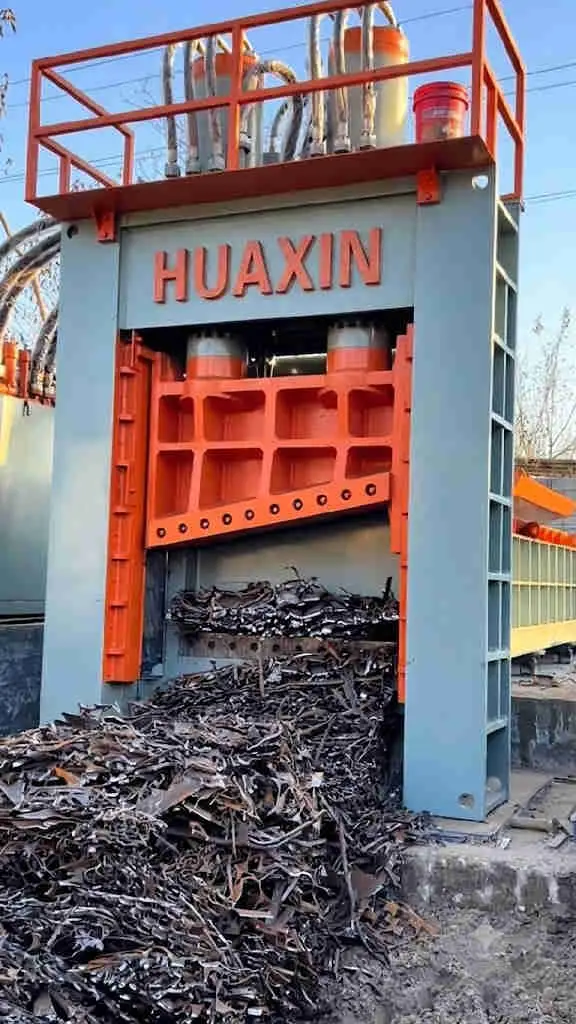
This article covers what 10 t/h demands, why the loading equipment decides it, and which force class in the gantry shear range covers it with headroom. All boundary figures are from published specifications; operational numbers are framed as arithmetic, not promises.
What 10 tons per hour adds up to
Ten tons an hour across eight hours is roughly 80 tons a day. Two shifts approaches 160. Those are production numbers, and they put the machine into a different conversation than the small-yard classes: the feed has to be near-continuous, the discharge has to clear at the box’s rate, and the maintenance window has to live inside the production schedule.
The Q91-630 carries this class of work: 60 mm plate continuous, 80 mm occasionally, and a duty rating that holds across three shifts. Its 60 to 80 tons per day published band covers a single shift at 10 t/h with room, and two shifts with the right feed arrangement.
Why the feeding method decides the rate
A gantry shear is fed by an excavator or a grapple, and the machine cuts at the speed the loader can supply. At 10 t/h the loader is not a detail; it is half the throughput equation. Three arrangements produce very different results:
- Dedicated grapple on the shear. The tank stays charged, the presets hold, the band is reachable. This is what the published figures assume.
- Shared excavator. The tank runs dry between fills, the crew compensates with surge feeding, and the surge overloads the discharge. Expect the bottom of the band.
- Conveyor or hopper feed. Works where material arrives prepared. With irregular feed it jams, and every jam costs more than the minute it takes to clear.
None of these is a machine choice. They are yard decisions, and they belong in the quotation conversation because the tank length and box geometry get specified against them.
The discharge half of the equation
At this rate the discharge zone fills faster than anyone expects. Sized material needs a destination that clears at the rate the box delivers it: a bay that fills to a truck, a conveyor to the next stage, or a sorting floor with the handling to match. The most common bottleneck at 10 t/h is not the machine; it is the pile of cut material waiting for a truck that arrives on someone else’s schedule.
Plan the flow at quotation. Discharge height, accumulation and the handling between box and destination all get confirmed against your layout, and the yards that do this commission in week one rather than rebuilding the connection in month two.
When 10 t/h points up or down the range
If your heaviest routine material stays under 50 mm and the day sits near 40 tons, the 500 Ton Scrap Metal Shear Machine (Q91-500) covers a single shift at this rate for less purchase price and less installed power. If your day genuinely runs past 160 tons, or the heavy tail includes continuous material past 60 mm, the 1000 Ton Scrap Metal Shear Machine (Q91-1000) is the production class.
The strokes-to-tonnage guide covers the arithmetic, and the range table shows the published bands side by side.
Why the hourly rate misleads
An hourly rate feels like a specification. It is closer to a claim, because it hides the three variables that produce it: how much each bite weighs, how often the cycle runs, and how much of the hour the machine actually spends cutting. Two yards can buy the same machine, quote the same rate, and deliver tonnages thirty percent apart.
The honest version of the conversation runs the other way. Describe the material, the loading arrangement and the shift pattern, and the tonnage the yard will produce falls out of the arithmetic. The computation guide walks the five steps, and the band guide explains the four assumptions behind any published figure. Both exist because the hourly rate on an inquiry form is the least reliable number in the purchase.
The class ladder at this rate
Three classes cover the 10 t/h question, and the choice between them is a material decision:
- Q91-500. 50 mm plate continuous, 65 mm occasionally. Covers a single shift at this rate where the material stays inside those boundaries. Less purchase price, less installed power, and the right answer for a yard whose heavy tail is genuinely light.
- Q91-630. 60 mm continuous, 80 mm occasionally, with a duty rating that holds across three shifts. This is the class the rate asks for when the material is mixed ferrous with a real heavy tail and the day runs toward 80 tons.
- Q91-1000. The production class, rated 100 to 120 tons per day. If your two-shift day approaches 160 tons, or the feed includes continuous material past 60 mm, this is where the conversation starts.
The force and material rule covers the headroom check, and the comparison guide walks the ladder below this rate.
How the quotation should read at this rate
A quotation that answers the 10 t/h question properly has four things in it. The class recommendation with its reason, so you can check the boundary rows against your own material list. The duty declaration restated as the build’s basis, so the machine that ships is the one specified for your shift pattern. The configuration decisions with their reasons: tank length against your loader, blade length against your weekly material, motor package against your supply. And the site package, so your electrician and foundation contractor build from the same sheet our engineers built from.
If any of the four is missing, the specification conversation is not finished, and the missing piece is usually the one that decides whether the machine reaches its band. The line-by-line guide maps what each section should contain, and the red-flag guide lists the patterns that should slow you down.
What the first month tells you
The first month at a new rate is diagnostic, and the log it produces is worth more than the brochure. Watch three things: the tons per shift against the band, the tons since the last blade rotation, and the minutes the tank spends empty. If the tonnage lands inside the band and the rotation interval holds, the configuration was right. If the tonnage sits low while the empty-tank minutes climb, the loading arrangement needs work rather than the machine. If the rotation interval collapses without a material change, look at the feeding discipline before you look at the blades.
None of those three needs an instrument, and all of them are cheaper to act on in month one than in year two. The cycle signatures guide covers what to watch from the control station, and the maintenance guide covers the rotation mechanics.
Diagnosing a feed-limited yard
Most yards that miss this rate blame the machine, and the machine usually reports its own health first. If the cycle stretches on routine material while hydraulic temperature stays normal, the machine is waiting for feed. If temperature climbs with the cycle, the system is working harder for the same cut, and that is an edge or blade-gap question rather than a loading one.
One normal week of three counts settles it: empty-tank minutes per shift, discharge-wait minutes per shift, and tons since the last blade rotation against the interval the configuration was quoted for. High empty-tank minutes with low discharge minutes means the loader is the constraint. High discharge minutes with a charged tank means the flow plan is the specification. Both low while the cycle still stretches is the reading buyers least expect: the blade rotation has slipped, and the fix is a logbook line rather than a purchase order. If all three are healthy, the material itself is the question and the force rule is the next check.
Run the counts on the median week, not the heaviest one and not the week the loader was in the shop. The heavy week flatters the feed and the light week damns it. Training belongs beside the counts: charge in rhythm rather than in surges, orient each piece for a clean cut, and watch the discharge zone as well as the box, because the pile is what stops the machine.
Buy the feed arrangement before the class
One sequencing point saves more money at this rate than any machine choice. Sort the loading arrangement before the class: if the excavator is shared, the first purchase is a dedicated grapple or a loader schedule, not a bigger shear. A yard with a disciplined feed reaches the band on the class its material actually needs. A yard without one reaches the bottom of the band on any class, and blames the tonnage.
The tank sizing guide covers the arithmetic, and the feed diagnostic covers how to tell which constraint you have before you spend anything.
Buyer FAQ
What daily tonnage does 10 tons per hour mean?
Roughly 80 tons on one shift and about 160 on two, assuming the feed keeps up. The multiplication is trivial; holding the rate through the shift is what takes the loading and discharge planning this article describes.
Which class covers 10 t/h honestly?
The Q91-630 covers a single shift at this rate within its published band, and two shifts with a feed arrangement that keeps the tank charged. The 500 class is worth pricing if your material is lighter; the 1000 class if your day runs past 160 tons.
Why is my shear not reaching its rated output?
Three usual causes, in order: the loader cannot keep the tank charged, the discharge zone fills faster than it clears, or blade rotation has slipped past its interval. All three are visible from the control station, and all three show up in the tonnage figure first.
What do you need from me to quote this rate?
Your material list with the three heaviest pieces from a normal month, the honest daily tonnage, the shift pattern, the loading equipment you have or plan to have, and your site’s power facts. The written quotation comes back within two business days with the class and configuration your numbers support, including when the honest answer is the class below the one you asked about.
Can a 500 ton machine really do 10 tons an hour?
On the right material, yes: a single shift at this rate sits inside the Q91-500’s published band where the feed stays under its 50 mm continuous boundary. The limit is not the hourly rate but the material. Past 50 mm as routine feed, the 500 is working at its edge every shift, and the 630 becomes the honest answer.
Planning a yard upgrade or need site-specific foundation drawings? Compare full machine parameters on our 630 Ton Scrap Metal Shear (Q91-630) page, review our hydraulic scrap shear lineup engineering hub, or contact HUAXIN’s Tangshan engineering team with your feedstock photos and target daily tonnage.
One Comment