
At this scale, nobody buys a shear on impulse. The decision involves a furnace, a power supply, a foundation and, usually, a board that wants to know why the number is so large. The question that comes up most is whether to stop at 1250 tons or step up to 1600. For yards evaluating heavy-duty scrap shear setups, operating benchmarks from our 1600 Ton Scrap Metal Shear (Q91-1600) show how hydraulic pressure stability and feeding habits directly shape cost per ton.
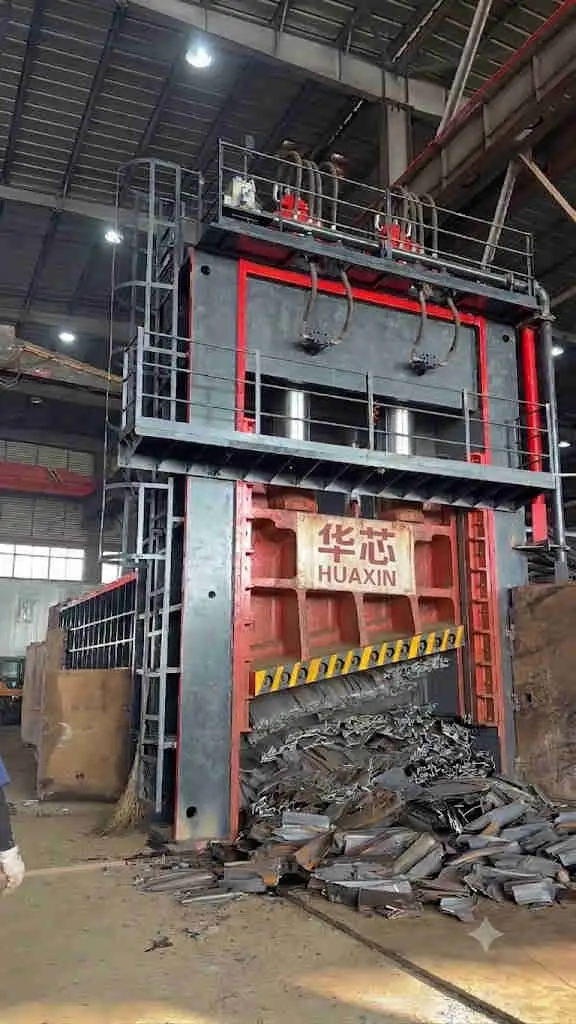
This article compares two machines from our range: the Q91-1250 and the 1600 Ton Scrap Metal Shear Machine (Q91-1600). All figures come from their product pages. We cannot tell you which is right for your plant without your data, but we can show you what separates them.
Two different jobs
The product pages frame these machines differently, and the framing is useful.
The Q91-1250 is described as a heavy-plate production line, built for plants whose intake is dominated by heavy plate and oversized sections rather than mixed yard scrap. The page says it is the tier where a shear stops being a yard machine and starts being a production line component.
The Q91-1600 is described as mill-scale shearing capacity, specified for mills and very large recycling bases where the shear is an integrated part of a production chain. It is specified for continuous three-shift duty.
Side-by-side figures
| Item | Q91-1250 | Q91-1600 |
|---|---|---|
| Plate, continuous | 120 mm | 150 mm |
| Plate, occasional | 150 mm | 190 mm |
| Blade length | 2,000 or 2,200 mm | 2,400 or 2,600 mm |
| Motor power | 4×45, 5×45 or 6×45 kW | 6×55 or 8×55 kW |
| Daily capacity | 160 to 200 t | 200 to 240 t |
| Feeding tank length | 7, 7.5 or 8 m | 7, 7.5 or 8 m |
| Power source | Grid, diesel generator or on-site power station | Grid or on-site power station |
| Baled scrap | Yes | Yes |
| Cycle time | 20 to 35 seconds | 20 to 35 seconds |
Two things stand out. Cycle times are the same, so the extra output at 1600 tons comes from handling heavier material and a larger machine, not from cutting faster. And the 1600 is listed for grid or on-site power station only, while the 1250 can also run from a diesel generator. That alone may matter for some sites.
What the extra 350 tons buys
According to the pages, the step up buys 30 mm more continuous plate capacity, longer blades, a larger motor package and a higher daily capacity band. It also buys a specification aimed at three-shift operation.
The page for the 1600 says the machine’s real specification at mill scale is availability, not force. It describes component selection, cooling and a maintenance plan built around continuous operation, and says a maintenance schedule and spares recommendation come with the machine. That matters if the shear feeds a furnace line that cannot afford to stop.
What it costs beyond the purchase price
The 1600 page is direct about this. Above roughly 200 tons per day, the machine stops being the only item on the bill. The power package, foundation, electrical supply and integration with intake and discharge systems all have to be designed together. The page says that a 1600 ton shear quoted without that context is a number without a plant behind it.
The 1250 page makes a related point from the other side. Above the 1000 ton class, every additional ton of force raises installed power, foundation cost and the energy released on every cut. The page positions 1250 tons as the point where a plant gets heavy-plate capability without stepping into the infrastructure of a mill-scale installation.
Put plainly, the 1600 may cost much more once the whole installation is counted. We cannot give you a figure, since it depends on your site, but you should budget for it from the start.
Shift pattern as a deciding factor
The 1250 page says two-shift running usually covers a plate-heavy plant’s requirement, and that three-shift operation is more often specified where the shear feeds a furnace line directly. The 1600 is built around three shifts.
So ask yourself how many hours the machine will really run. If you plan two shifts at 160 to 200 tons per day, the 1250 is likely enough. If you run three shifts continuously and the shear sits directly in front of a furnace, the 1600 starts to make sense. If you are not sure, model both against your actual intake pattern, not maximum loading.
Plate thickness: be realistic
It is tempting to buy for the thickest plate you might ever see. The pages give a better approach. Look at what you cut regularly. If your regular plate sits at or below 120 mm, the 1250 covers it continuously. If it sits closer to 150 mm, the 1600 does.
The page for the 1250 says daily plate above 150 mm or throughput above 200 tons per day points to the 1600. The page for the 1600 says daily plate above 190 mm or throughput above 240 tons per day points to the 2000 ton flagship. Occasional heavy pieces should not drive the daily purchase.
Bales, rebar and mixed intake
Both machines are specified to cut baled scrap, and both list HMS 1 and 2 as continuous duty. Both also cut rebar, including reinforcement still tied into concrete from demolition work, according to their pages.
So the material list does not separate them. The separation is in thickness, volume and duty pattern. If your intake mixes bales with heavy plate and rebar, either machine can handle the mix. Pick based on tons per day and shifts.
Applications named on each page
The 1250 page lists rebar-reinforced demolition intake, plate stems and crop ends, structural steel and beam scrap, and furnace feeding at mills and foundries.
The 1600 page lists internal mill scrap loops, railway and bridge scrap, foundry and steel-plant heavy returns, and integrated bases with mixed intake.
If your work resembles the first list, start with the 1250. If it resembles the second, especially internal mill loops and rail scrap on a three-shift schedule, look at the 1600.
Blade consumption is part of the economics
Heavy plate wears edges faster than mixed ferrous. Both machines use H13 or M6V tool steel at 56 to 62 HRC, four-sided reversible, and both pages say the regrind interval is stated for your material mix in the quotation. The 1250 page goes further and says blade life per ton and charge consistency are modeled alongside force.
When you compare quotations from any supplier, ask for that interval and the assumptions behind it. Blade cost per ton can matter more over time than the difference in purchase price.
Looking one step down and one step up
The pages also point to neighbors. If 100 mm plate and about 120 tons per day describe your duty, the 1000 ton class is the more economical machine. If you are above 240 tons per day, the 2000 ton flagship is the tier that matches. Our article on installing a 1000 ton shear also covers the site issues that grow as you climb.
Questions to bring to the conversation
- What plate thickness do I cut every day, not once a year?
- How many shifts will this machine run?
- Does the shear feed a furnace directly?
- What power can my site really supply, and is a generator involved?
- What does the full installation cost, including foundation and electrical work?
- What is my blade interval and cost per ton on this material?
Required Yard Parameters for 1250 Ton vs. 1600 Ton Gantry Shear
For either machine, the pages ask for your material mix with plate and bale share, heaviest plate or section, target tons per day, shift pattern, feeding method, site power and the furnace or end use. For mill-scale quotations on the 1600 we also ask about plant layout and control integration.
Send them through our contact page. Both pages say we will recommend a different class if your numbers point that way, and we mean it.
Planning a yard upgrade or need site-specific foundation drawings? Compare full machine parameters on our 1600 Ton Scrap Metal Shear (Q91-1600) page, review our hydraulic scrap shear lineup engineering hub, or contact HUAXIN’s Tangshan engineering team with your feedstock photos and target daily tonnage.
One Comment