
At this scale, nobody buys a shear on impulse. The decision involves a furnace, a power supply, a foundation and, usually, a board that wants to know why the number is so large. The question we hear most is whether to stop at 1250 tons or step up to a 1600 ton gantry shear. Both machines run the same 20 to 35 second cycle, so the answer comes down to plate thickness, daily tonnage, shift pattern and the infrastructure you are prepared to build. For yards still sizing a heavy-duty scrap shear, this comparison sets the two top-end models side by side.
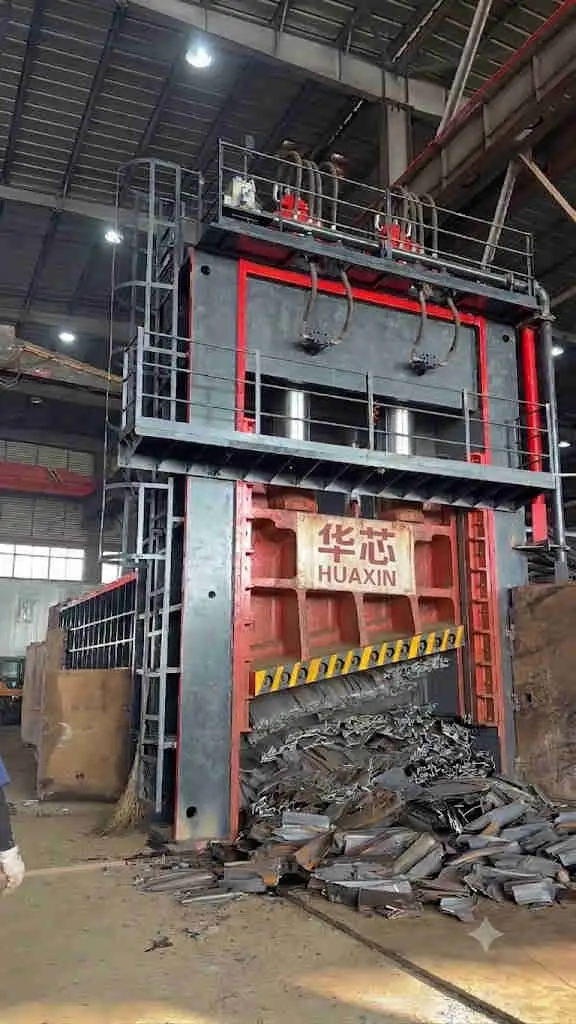
This article compares two machines from our range: the 1250 ton gantry shear and the 1600 ton model. All figures come from their product pages. We cannot tell you which one fits your plant without your data. We can show you what separates them.
Two different jobs
The product pages frame these machines differently, and the framing is useful.
The 1250 ton shear is described as a heavy-plate production line. It is built for plants whose intake is dominated by heavy plate and oversized sections rather than mixed yard scrap. In our range, this is the tier where a shear stops being a yard machine and becomes a production line component.
The 1600 ton shear is mill-scale shearing capacity. It is specified for steel mills and very large recycling bases where the shear is one link in a production chain, and it is built for continuous three-shift duty.
1250 vs 1600 ton gantry shear: side-by-side figures
| Item | Q91-1250 | Q91-1600 |
|---|---|---|
| Shearing force | 1,250 t (12,500 kN) | 1,600 t (16,000 kN) |
| Max plate, continuous (mild steel) | 120 mm | 150 mm |
| Blade length | 2,000 or 2,200 mm | 2,400 or 2,600 mm |
| Motor power | 4×45 to 6×45 kW | 6×55 or 8×55 kW |
| Minimum transformer | 232 / 288 / 344 kVA | 419 / 557 kVA |
| Output (10-hour day) | 16–20 t/h, 160–200 t/day | 20–24 t/h, 200–240 t/day |
| Feed box length | 7, 7.5 or 8 m | 7, 7.5 or 8 m |
| Baled scrap | Yes | Yes |
| Cycle time | 20 to 35 s | 20 to 35 s |
Two things stand out. Cycle times are identical, so the extra output at 1600 tons comes from heavier charges and a longer blade, not from faster cutting. The feed box options are also the same, which means the intake layout does not have to change if you move up a class. Both models can be built for grid power, a generator or diesel drive, so the power source rarely decides between them. The transformer figure does. Each kVA value is the minimum for the matching motor package, worked out as (motor kW + 5) / 0.8 and rounded up.
What the extra 350 tons buys
The step up buys 30 mm more continuous plate capacity, 400 mm more blade, a larger motor package and a higher daily band. It also buys a specification aimed at three-shift operation.
At mill scale, the 1600 page treats availability as the real specification, ahead of force. Component selection, cooling and the maintenance plan are built around continuous running, and a maintenance schedule and spares recommendation come with the machine. That matters if the shear feeds a furnace line that cannot afford to stop.
What it costs beyond the purchase price
The 1600 page is direct about this. Above roughly 200 tons per day, the machine stops being the only item on the bill. The power package, foundation, electrical supply and the link to intake and discharge systems all have to be designed together. A 1600 ton shear quoted without that context is a number without a plant behind it.
The 1250 page makes a related point from the other side. Above the 1000 ton class, each extra ton of force raises installed power, foundation work and the energy released at each cut. It positions 1250 tons as the point where a plant gets heavy-plate capability without the infrastructure of a mill-scale installation.
Put plainly, the 1600 can cost much more once the whole installation is counted. The gap depends on your site, so budget for it from the first meeting.
Shift pattern as a deciding factor
Both output bands are stated on a 10-hour working day. The 1250 page says two-shift running usually covers a plate-heavy plant, and that three shifts are more often specified where the shear feeds a furnace line directly. The 1600 is built around three shifts from the start.
Count the hours the machine will really run. A two-shift plant whose intake fits inside 160 to 200 tons per 10 working hours is usually well served by the 1250. Run three shifts with the shear sitting directly in front of a furnace, and the 1600 starts to make sense. If you are unsure, model both against your actual intake pattern rather than peak loading.
Plate thickness: be realistic
It is tempting to buy for the thickest plate you might ever see. A better approach is to look at what you cut every week. If your regular plate sits at or below 120 mm, the 1250 covers it continuously. Closer to 150 mm, you need the 1600.
Regular plate above 120 mm or throughput above 200 tons per day points from the 1250 to the 1600. Regular plate above 150 mm or more than 240 tons per day points on to the 2000 ton flagship, rated for 170 mm. One or two heavy pieces a month should not drive the purchase.
Bales, rebar and mixed intake
Both machines cut baled scrap, and both treat HMS 1 and 2 as continuous duty. Both also cut rebar, including reinforcement still tied into concrete from demolition work.
So the material list does not separate them. Thickness, volume and duty pattern do. If your intake mixes bales with heavy plate and rebar, either machine can take the mix, and tons per day plus shifts should decide.
Applications named on each page
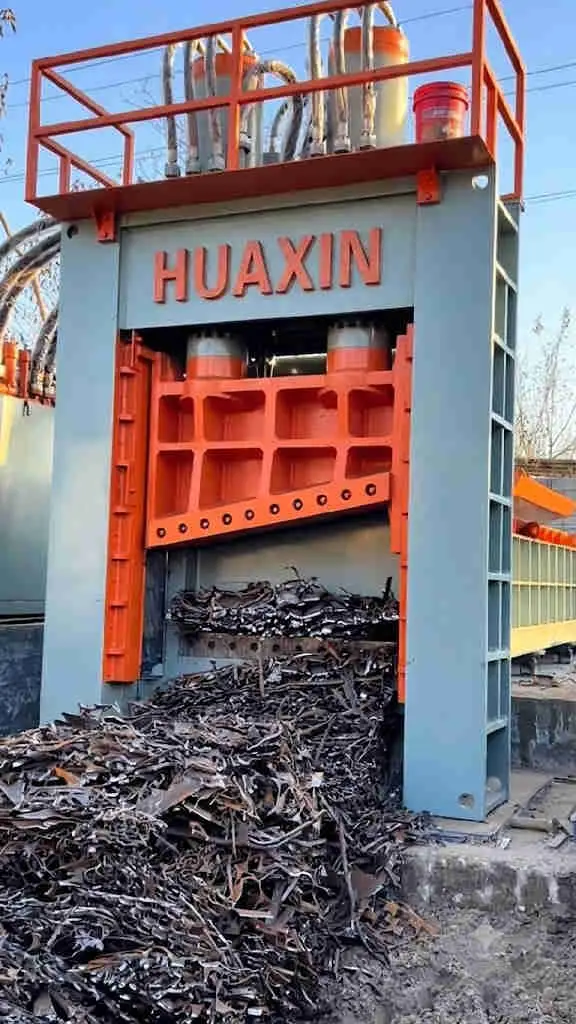
The 1250 page lists rebar-reinforced demolition intake, plate stems and crop ends, structural steel and beam scrap, and furnace feeding at mills and foundries.
The 1600 page lists internal mill scrap loops, railway and bridge scrap, foundry and steel-plant heavy returns, and integrated bases with mixed intake.
Work that resembles the first list should start with the 1250. Internal mill loops and rail scrap on a three-shift schedule belong with the 1600.
Blade consumption is part of the economics
Heavy plate wears edges faster than mixed ferrous scrap. Both machines use four-edge reversible blades in M6V, H13, X45 or D2 tool steel, and the regrind interval for your material mix is stated in the quotation. On the 1250, blade life per ton and charge consistency are modelled alongside force.
When you compare quotations from any supplier, ask for that interval and the assumptions behind it. Over ten years, blade cost per ton can outweigh the difference in purchase price.
Looking one step down and one step up
If 100 mm plate and about 100 to 120 tons per day describe your duty, the 1000 ton class is the more economical machine. Above 240 tons per day, the 2000 ton flagship is the tier that matches. Our article on installing a 1000 ton shear covers the site issues that grow as you climb.
Points to settle before you ask for a quote
- The plate thickness you cut every week, not once a year.
- The number of shifts the machine will run.
- Whether the shear feeds a furnace directly.
- The power your site can really supply, and whether a generator is involved.
- The full installation budget, including foundation and electrical work.
- Blade interval and blade cost per ton on your own material.
Yard data we need for a 1250 or 1600 ton quotation
For either machine, send your material mix with plate and bale share. Add the heaviest plate or section, target tons per day, shift pattern, feeding method, site power and the furnace or end use. For mill-scale 1600 ton projects we also ask about plant layout and control integration.
Send them through our contact page and you receive a written quotation within 48 hours. If your numbers point to a different class, we will say so.
Planning a yard upgrade? Review the full hydraulic gantry shear series, or contact HUAXIN’s Tangshan engineering team with your feedstock photos and target daily tonnage.
2 Comments