
Five tons an hour is the first production rate where buyers start shopping by tonnage instead of by budget. It sounds modest. Run it for eight hours and you have moved forty tons of scrap, which is a real day’s work for a small yard and a rounding error for a mill. The mistake at this rate is buying a machine rated for the average and discovering the peaks. If you are comparing gantry and alligator shear configurations, production runs on the 500 Ton Scrap Metal Shear (Q91-500) illustrate how cutting force and operator discipline impact hourly output.
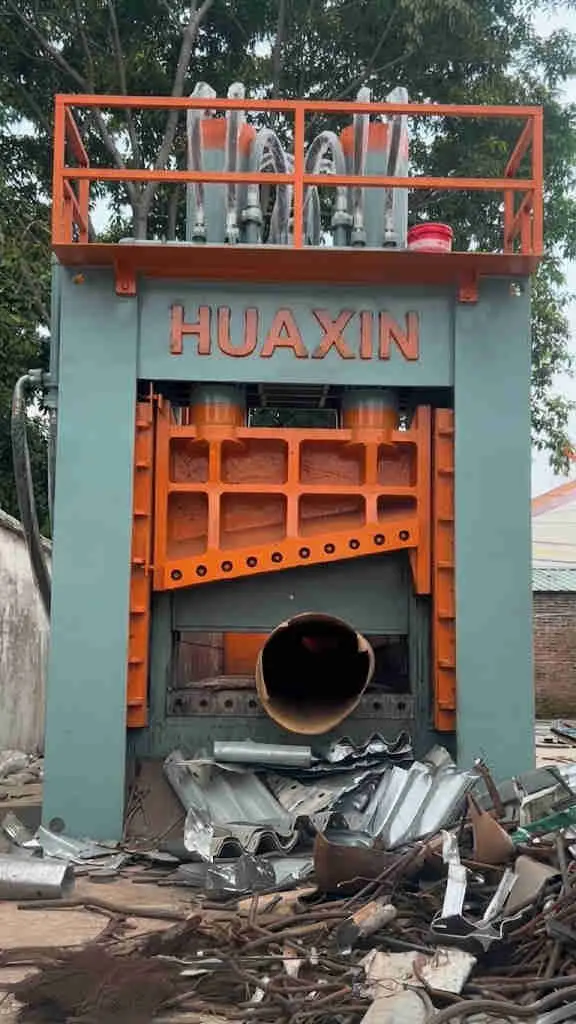
This article walks through what 5 t/h demands, how it converts into daily tonnage, and which force class in our scrap metal shear range covers it without living at its boundary. All the boundary figures come from the published specifications on the product pages. Where a number depends on your material, I say so rather than invent one.
What 5 tons per hour means in practice
Throughput is not a machine property on its own. It is the machine’s cycle rate multiplied by how much material each bite takes, minus the time the machine spends waiting. A shear with a 20 to 30 second cycle can turn out very different tonnages depending on whether the excavator keeps the box charged and whether the discharge clears.
At 5 t/h across an eight-hour shift you are planning for roughly 40 tons a day. Two shifts nearly doubles that. The class you need follows from the material, not from the hourly rate: if your feed includes continuous plate in the 40 to 50 mm range, you are in 500-ton territory regardless of what the hour meter says.
Why the Q91-500 fits this rate
The Q91-500 carries 50 mm plate as continuous duty and takes 65 mm occasionally. That boundary matters more at 5 t/h than at lower rates, because a machine working at its edge every shift stretches cycle time, shortens blade intervals and pushes hydraulic temperatures up. The 500 leaves headroom for the heavy tail of a normal week.
Three configurations decide whether you actually reach the rate:
- Feeding tank length. A tank that empties between excavator fills starves the cycle. Size it against your loader’s cycle time, not against the brochure default.
- Blade length. If your typical piece needs repositioning to fit the blade, every reposition is a minute you do not get back. The weekly material picks the blade, not the other way around.
- Discharge arrangement. Cut pieces that bank up under the box stop the machine as effectively as a mechanical fault.
The published configuration rows on the product page show the options. Our tank sizing guide covers the arithmetic.
What 5 t/h does not fix
A shear at this rate sizes material. It does not densify light scrap and it does not liberate anything. If a large share of your tonnage is loose light material, the honest answer is a baler behind the shear, or instead of it. If your intake is mixed bulky waste, a shredder does that job.
Also worth saying plainly: 5 t/h is achievable, not automatic. The same machine turns out 3 t/h in a yard where the crane is shared and 7 t/h where a dedicated grapple keeps the box charged. The machine is the same; the operation is not.
When 5 t/h points at a different class
If your heaviest routine material runs past 50 mm continuously, the 500 is working at its boundary every shift and the honest step is the 630 Ton Scrap Metal Shear Machine (Q91-630), which carries 60 mm continuous and 80 mm occasionally. If your daily tonnage is genuinely under 30, the 400 Ton Scrap Metal Shear Machine (Q91-400) at 40 mm continuous does the job for less money and less installed power.
The class comparison guide walks the ladder, and the band reading guide explains what the published figures assume.
The arithmetic that connects rate to class
Buyers arrive with an hourly rate and factories answer with a force class, and the bridge between them is daily tonnage. The multiplication is simple enough to do on a phone: 5 t/h across one eight-hour shift is roughly 40 tons, across two shifts about 80. What that daily number then decides is not the tonnage badge but the material boundary you need, and that boundary is where the published specifications do the talking.
Material density moves the same hourly rate into very different tonnage figures, which is why the rate alone cannot pick a class. A box charged with dense HMS moves more weight per bite than the same box charged with light mixed scrap, and the cycle time is the same in both cases. This is the honest reason a quotation starts with your material list rather than with the rate you typed into the inquiry form.
Where the feed is consistent and the material is described honestly, the published bands hold. The band reading guide covers the four assumptions behind any figure a factory quotes, and the computation guide walks the five steps from cycle rate to shift tonnage with your own numbers in them.
The site facts to confirm before the deposit
Five confirmations should exist in writing before money moves, and four of them come from your side. The voltage and frequency your supply actually delivers, the spare kilowatts after the yard’s existing load, the foundation conditions where the machine will sit, and the route the crate travels into the yard. The fifth is the factory’s: the class recommendation restated against your material list, with the boundary rows for the quoted class.
These four site facts are not paperwork. They are the difference between a machine that commissions in week one and a machine that arrives into a problem. A motor built for the wrong voltage is not adapted, it is rebuilt, and a starting method your supply cannot deliver gets discovered on the day the production plan was waiting. Send the four facts with the inquiry and the electrical scope and foundation data come back confirmed in writing before the build starts.
Running 5 t/h across two shifts
Two shifts at this rate is roughly 80 tons a day, and that is a different machine from the one-shift yard even though both write 5 t/h on the inquiry form. Blade rotation is tonnage-based, so the interval arrives twice as often, and seal kits, filters and hoses follow the same curve. The force class still follows your heaviest material; what the second shift changes is the build. Frame specification, hydraulic package, cooling capacity and wear-liner strategy all follow the declared duty, which is why a machine quoted for one shift and run on two shows it as stretched cycles, shorter blade intervals and warmer oil rather than as a fault.
The second shift also moves the maintenance window inside the production plan, and it makes the handover the place where the day’s knowledge survives. A board at the control station, a two-minute conversation and a line in the log carry what the material did to the edges and how the cycle felt late in the shift. Post the material boundary there too, so the incoming crew charges to the daily diet rather than pushing the occasional rating every shift.
When the quotation arrives, three rows show whether the duty was heard: frame and hydraulic rows that reference your shift pattern, cooling and wear rows that scale with the declared duty, and a spares list sized to two shifts rather than one. If any of them is missing, ask for it in writing before the deposit; the line-by-line quotation guide maps what each section should carry.
Why blade planning matters more at this rate
Five tons an hour is enough tonnage that the wear line stops being occasional. A yard at 20 tons a day rotates blades on a schedule it can improvise; a yard at 40 does not, because the interval arrives twice as often and an unplanned rotation costs a shift. The blade log earns its keep here: tonnage and dominant material per rotation, three months of it, and the interval your material actually needs stops being a guess.
The maintenance guide covers the mechanics, and the Q91-500 page carries the blade specification rows worth checking against your material before the order.
Buyer FAQ
What daily tonnage does 5 tons per hour add up to?
About 40 tons in an eight-hour shift, and roughly 80 across two shifts, assuming the feed and discharge keep up. The arithmetic is simple; holding the rate through the shift is the part that takes planning.
Is a 500 ton shear right for 5 t/h?
It covers the rate with headroom on material up to 50 mm continuous plate. If your heaviest routine feed is lighter than that and your tonnage is stable, the 400 class is worth pricing too. The material list decides, not the hourly rate.
What stops a yard from reaching its rated throughput?
Usually three things: an excavator that cannot keep the tank charged, a discharge zone that fills faster than it clears, and blade rotation slipping past its interval. All three are operational, and all three show up in the tonnage figure before they show up anywhere else. A week of counting empty-tank minutes, banked-discharge minutes and tons since the last rotation settles which one you have, and none of the three counts needs an instrument.
How do I get a recommendation in writing?
Send your material list, the three heaviest pieces from a normal month, your honest daily tonnage and your shift pattern. You will have a written recommendation within two business days, including when the answer is the class below the one you asked about. We would rather quote the right machine once than sell the wrong one and meet you again at the second purchase.
Does the hourly rate or the daily tonnage pick the class?
The daily tonnage, filtered through the material. The hourly rate is an input to that number, but two yards at the same rate can need different classes if one runs dense material and the other runs light mixed scrap. The heaviest routine piece is the final check, because the class has to cover the heavy tail of a normal week, not the average day. One more habit separates the yards that hit their band from the yards that wonder why they do not: they write the tonnage down. A daily figure in a logbook, next to the dominant material, turns the machine’s output into a trend you can manage rather than a number you argue about. Three months of that log is also the document that makes the second purchase easy, because the specification writes itself from your own records.
Evaluating equipment specifications or FOB/CIF delivery schedules for your plant? Compare full machine parameters on our 500 Ton Scrap Metal Shear (Q91-500) page, review our scrap metal shear engineering hub engineering hub, or contact HUAXIN’s Tangshan engineering team with your feedstock photos and target daily tonnage.
One Comment