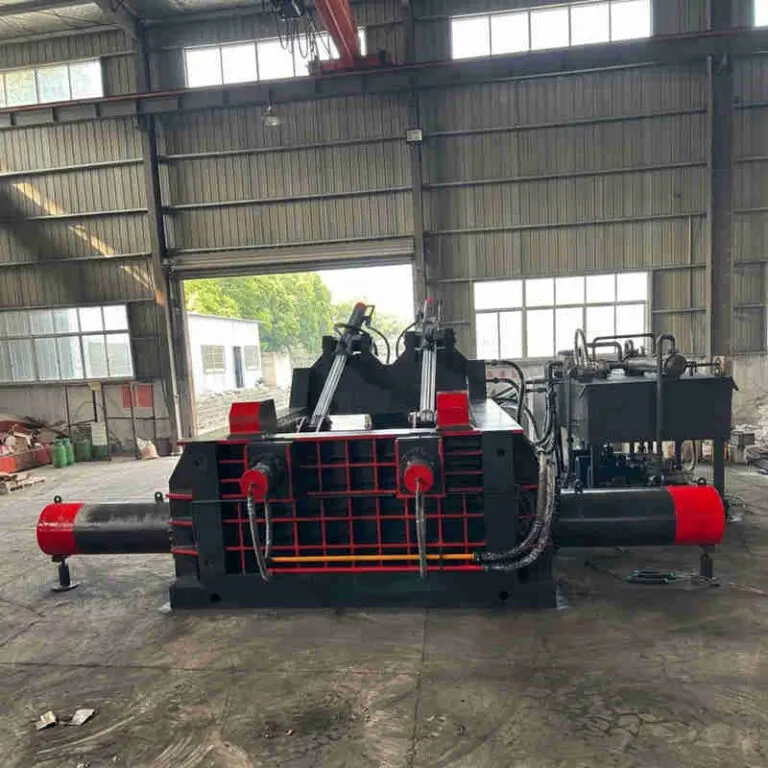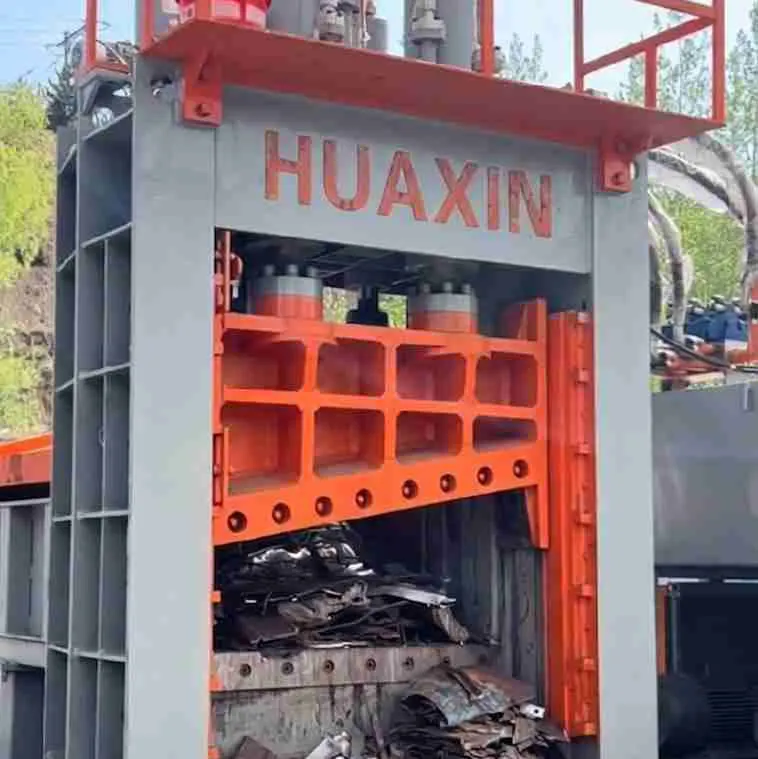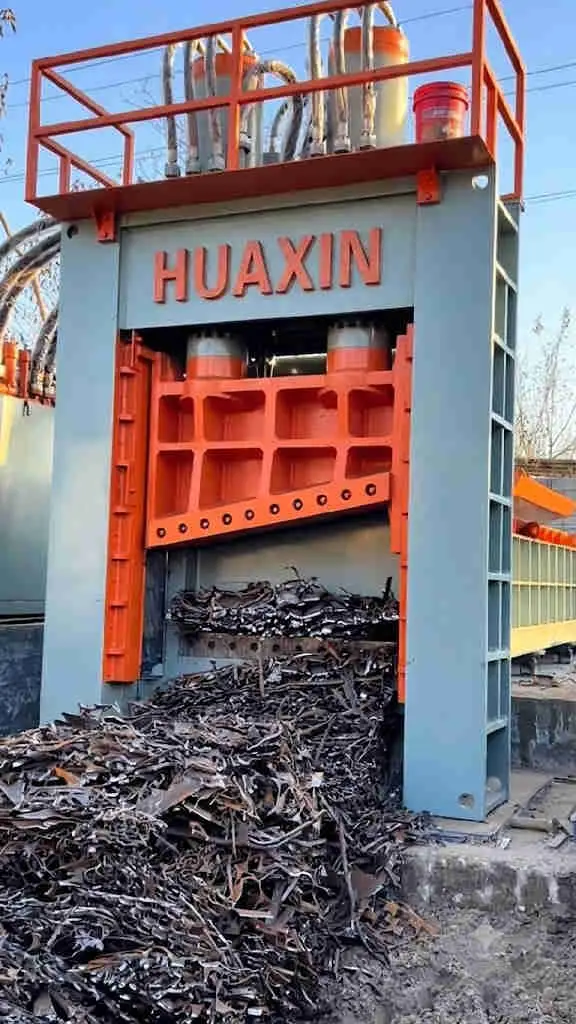
A specification sheet tells you what a heavy shear is rated for. A factory test and a working customer site show you how it behaves. This post follows one 500 ton gantry shear from our Tangshan workshop to a customer’s recycling facility, where it was installed for H-beams, large steel pipe and heavy industrial offcuts. Along the way it explains what a buyer can verify before shipment and what to plan in the first months on site. If you are still comparing gantry and alligator shear layouts, the same checks apply to both.
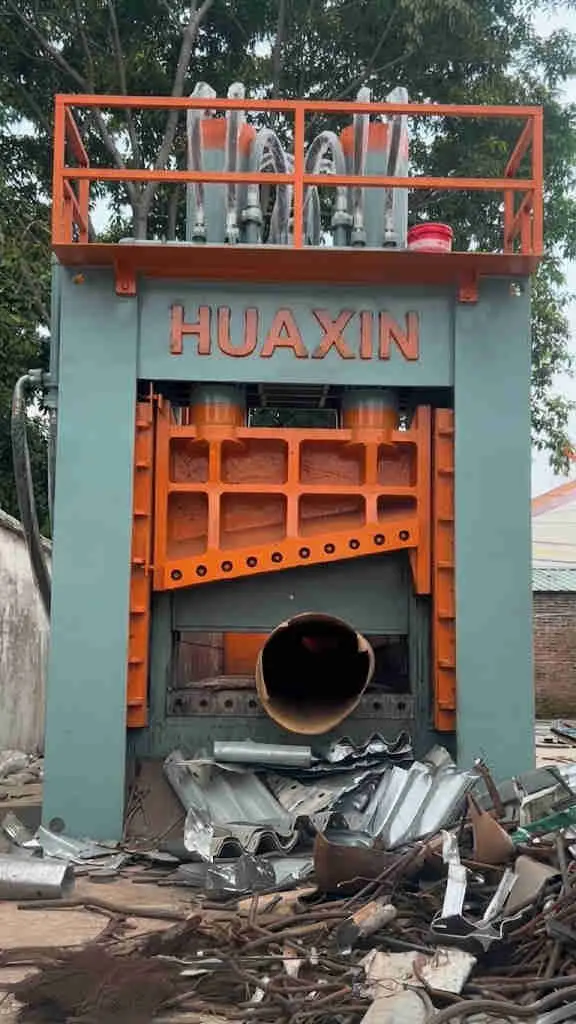
This 500 ton scrap metal shear was load-tested at our factory before shipment. The buyer can watch that test by video before the machine leaves Tangshan. After shipping, it was installed at the customer’s facility for heavy-duty scrap processing, with H-beams and steel pipe in the material mix.
The project gives a practical view of three stages: the factory test, installation on site, and the materials the machine is meant to handle once it is running.
Looking for full machine specifications and a factory-direct quotation?
500 ton model: 500 t (5,000 kN) shearing force. 4.5–6.0 t/h, or 45–60 t/day. 50 mm continuous mild steel plate. 1,400 or 1,500 mm blade.
View full specifications and videos, and request a quote. | Browse all hydraulic gantry scrap metal shears.
Watch the 500 Ton Gantry Shear Factory Test and Customer Installation
The video below shows this hydraulic scrap shear during factory testing and again after installation at the customer’s site.
Watch the full 500-ton shear test video on YouTube.
The Factory Test: What It Checks
Before delivery, every machine of this size is load-tested at the factory. The test runs the shear under working pressure so the hydraulic system, blades and frame are checked together, not one by one on a bench.
Buyers do not need to travel to see it. We arrange a video of the test, so the customer can watch the machine cut and confirm the blade gap, cylinder movement and PLC cycle before it is packed.
The rated figure to keep in mind is 50 mm mild steel plate as continuous duty. That is what the 500 ton class is built to cut day after day, and it is the number we size against when we quote.
A factory test is useful as a reference. It does not replace matching the machine to your own material, and we treat it that way.
What Decides Whether Thick Plate Cuts Cleanly
Thick plate is harder work than thin sheet or light scrap. Several factors set the force a cut needs:
- Steel grade: different grades have different tensile and shear strength.
- Thickness: thicker steel needs more force, and 50 mm mild steel is this model’s continuous limit.
- Cutting width: how much material the blade engages changes the load.
- Blade condition: geometry, clearance and wear all affect the cut.
- Hydraulic performance: the system has to hold force through the whole stroke.
Real cutting capacity always depends on the material and the operating conditions, not on the force rating alone.
If you process thick plate, send us the steel grade, thickness and width. Plate that regularly runs above 50 mm is a job for the 630 ton model, rated for 60 mm.
See the 500 ton model’s full specifications on the product page linked above →
From Factory Test to Customer Site
After the factory test, the machine was shipped and installed at the customer’s facility.
Moving a large hydraulic shear from the workshop to a working yard involves more than freight. Site preparation, positioning on a reinforced concrete foundation built to our civil drawings, hydraulic checks and electrical connection are all part of the job. Our field engineers handle installation, commissioning and operator training.
At this facility the shear is meant for heavy ferrous scrap, including structural steel and large-diameter pipe.
Materials the Customer Plans to Process
The customer’s material list includes these items.
- H-beams and structural steel sections.
- Large-diameter steel pipe, which the customer listed at up to about 600 mm outside diameter.
- Heavy steel scrap and industrial offcuts.
- Other ferrous material from industrial processing and recycling.
Whether each piece cuts in one stroke depends on wall and flange thickness, not just on outside size. We cover that below.
Both stages appear in our 500-ton shear project video.
The First Months on Site
The first months decide how the machine runs for years. Three things matter most in that period.
Commissioning sets the baseline. Blade gap, PLC presets and hydraulic pressure are set during commissioning. Write them down. Every later check is measured against that first record.
The crew learns the feed. Operators coming from a smaller machine tend to push thicker material in. On a 500 ton shear the daily limit is 50 mm plate. Our feeding discipline guide covers sorting, orientation and bundling.
The blade log starts on day one. Log each edge rotation with the tonnage and main material since the last one. A few months of entries show the real interval for your scrap mix.
The machine comes with a 12-month warranty. Keep one spare blade set on the shelf so a worn set never holds up a shift.
Can a 500 Ton Scrap Metal Shear Cut H-Beams?
H-beams are used in buildings, bridges and factories. They turn up often in demolition scrap and industrial recycling.
Their shape and stiffness make them hard to cut with light equipment.
A heavy hydraulic shear is a practical way to reduce them, as long as the machine matches the beam size and steel grade.
Factors That Affect H-Beam Cutting
When choosing a shear for structural steel, check:
- Flange thickness: thicker flanges increase cutting resistance.
- Web thickness: the central section adds to the load.
- Beam size: the section has to fit the blade opening, which is 1,400 or 1,500 mm long on this model.
- Steel strength: high-strength structural steel can need more force.
- Cutting position: orientation changes how the blade loads.
The 500 ton class is built for heavy steel work, including suitable structural sections.
For specific beam sizes, confirm the cutting requirement with us before you order.
Processing Large-Diameter Steel Pipe
Large steel pipe is common in industrial demolition, infrastructure recycling and steel processing.
Uncut pipe takes up a lot of space in the stockpile and on trucks, so cutting it into short lengths is a key step before it goes to a mill.
In this customer’s mix, the largest pipe was listed at about 600 mm outside diameter.
Diameter alone does not decide whether a shear can cut a given pipe.
Why Pipe Wall Thickness Matters
Take two pipes with the same outside diameter.
One has an 8 mm wall. The other has a 25 mm wall.
The outside size is identical, but the amount of steel under the blade is very different.
The thicker pipe needs far more force.
Steel grade, cutting orientation and blade geometry also change the requirement.
When you ask about a hydraulic scrap metal shear for pipe cutting, send us the following.
- Maximum pipe outside diameter.
- Maximum wall thickness.
- Steel grade or material type.
- Required cut length.
- Expected hourly or daily volume.
With those figures we can tell you whether a 500 ton shear fits or whether the job needs a heavier class.
How a 500 Ton Hydraulic Scrap Shear Works
Hydraulic cylinders drive the blade.
Material is placed in the feed box, which is 5, 5.5 or 6 m long on this model. A hold-down clamps it, and the blade comes down under hydraulic pressure.
The PLC runs the cycle automatically in 20 to 35 seconds, and the operator can also work it by remote control. An emergency stop sits on both.
Cutting capability comes from several things working together: hydraulic pressure, cylinder size, blade geometry, frame design and the steel itself.
The 500 t (5,000 kN) rating is an important figure. It is not a guarantee for every size or grade of steel.
When you compare shears, watching real cutting footage adds information a datasheet cannot give.
Why Recycling Plants Use Heavy Scrap Shears
Industrial recycling plants receive bulky steel that has to be cut to manageable size before shipping or further processing.
A heavy scrap shear prepares that material for the next stage.
1. Size Reduction of Heavy Steel Scrap
Long structural sections, pipe and heavy offcuts are cut into shorter pieces.
Shorter pieces are easier to handle with a grapple or magnet.
2. Easier Scrap Handling
Oversized scrap causes trouble in storage, sorting and transport, because long pieces tangle in the pile, block the magnet and leave empty space in every truck and container they are loaded into.
Cutting it down helps a yard keep its stockpiles organised.
3. One Machine for Several Ferrous Materials
A correctly sized shear handles plate, structural sections and pipe within its limits.
That flexibility helps yards that take in mixed industrial scrap.
4. Less Manual Torch Cutting
Hydraulic shearing reduces repetitive torch work on suitable heavy scrap.
Safe operation still needs trained staff, proper handling equipment and regular maintenance.
5. Better Truck and Container Loading
Shorter pieces load more densely.
The real gain depends on the shape, size and density of the scrap.
See our full range of hydraulic scrap metal shear machines for other applications.
What to Check Before Buying a 500 Ton Shear
A shear of this size is a major investment.
Choosing it well takes more than comparing force ratings on two quotations, since two machines with the same 500 t badge can differ in box length, motor package and how the hydraulics are built.
Material Type and Maximum Size
Start with the materials your yard processes most often.
For plate, give thickness, width and steel grade.
For H-beams, give flange thickness, web thickness and overall size.
For pipe, give outside diameter and wall thickness.
Required Capacity
Estimate how much scrap you need to process in a normal day.
The rated output for this class is 4.5 to 6.0 t/h, or 45 to 60 t in a 10-hour day. Where you land in that band depends on material, cycle time and how well the box is fed.
Hydraulics, Blades and Power
Ask about maintenance.
Blades are M6V, H13, X45 or D2 tool steel with four reversible edges. The drive is 2×37 kW or 2×45 kW, so check your site supply early. A 2×37 kW machine needs at least a 99 kVA transformer, and 2×45 kW needs 119 kVA.
Factory Testing and Inspection
Ask to watch the factory load test by video, and ask for cutting footage on material close to your own scrap.
Installation and Support
Large machines need site preparation.
Confirm installation requirements, technical documents and after-sales service before you order.
Choosing a Scrap Metal Shear Manufacturer in China
China is a major source of scrap recycling equipment, including hydraulic shears and balers.
Machines with the same advertised force can still differ in frame build, hydraulic components, box size and real capability.
When you evaluate a scrap metal shear manufacturer in China, look past the basic description.
Ask for factory test video, machine footage, full specifications, maintenance requirements and installation examples.
This project shows one machine at two stages: on the test floor and on a customer site.
At Scrap Recycling Machine, Huaxin Co., Ltd. has built scrap metal machinery in Tangshan since 1989 and has exported to 30+ countries. Machines carry CE and ISO 9001 certification.
You can discuss material sizes, capacity and configuration with our team before choosing a machine.
500 Ton Gantry Shear FAQ
What plate thickness can a 500 ton scrap metal shear cut?
It is rated for 50 mm mild steel plate as continuous duty. Real capacity depends on steel grade, cutting width, blade condition and operating conditions. Plate that is regularly thicker belongs on the 630 ton model.
Can a 500T scrap shear cut H-beams?
Yes, many H-beams and structural sections are within its range. The limit depends on flange thickness, web thickness, beam size and steel strength.
Can a 500-ton shear process 600 mm steel pipe?
The customer in this project listed pipe up to about 600 mm outside diameter. Whether a pipe cuts depends mainly on wall thickness and steel grade. Send full pipe specifications before we confirm the machine.
Is the machine tested before shipment?
Yes. Every machine is load-tested at the factory before shipment, and you can watch the test by video before it is packed.
What does a 500-ton shear cost?
Price depends on configuration, motor package, feed box length, options and shipping terms (EXW, FOB or CIF). Send your material details and we return a written quotation within 48 hours.
Where can I buy a 500 ton scrap metal shear from China?
Contact Scrap Recycling Machine (Huaxin Co., Ltd.) for details on our 500 ton model and the rest of our metal recycling equipment.
See the 500 Ton Shear in Action
Factory test footage shows a heavy shear in a way a specification table cannot.
This project shows the machine under load at the factory and then installed at a customer’s plant.
The customer will use it for H-beams, heavy offcuts and large-diameter pipe, within the material limits described above.
Watch the video to see the machine and its applications.
Watch the 500-ton shear factory test and customer installation video →
Need a 500 Ton Shear for Your Recycling Business?
If your plant handles heavy plate, H-beams, structural steel or large pipe, the right shear makes a real difference to daily throughput.
We size equipment on your actual scrap dimensions, steel grades and target tonnage.
For a quotation, send the metals you process, the largest dimensions and your expected daily volume.
Comparing specifications or FOB/CIF delivery for your plant? See the full model data for the Q91-500 and browse our scrap metal shear range. You can also contact HUAXIN’s Tangshan engineering team with feedstock photos and target daily tonnage for a written quotation within 48 hours.