
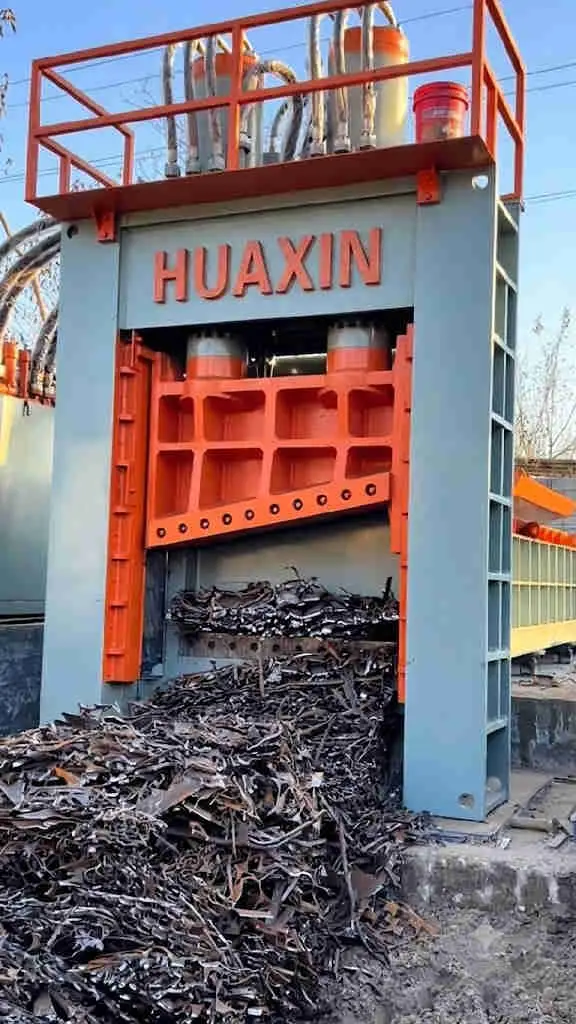
One hundred tons a day is the rate where a yard becomes a plant. The machine conversation is still important, but the loading arrangement, the discharge plan and the maintenance window start deciding whether the tonnage is real. This article covers what 100 t/day demands and which class covers it honestly. When sizing hydraulic scrap shear equipment for continuous duty, field data on the 630 Ton Scrap Metal Shear (Q91-630) highlights the link between frame rigidity, cycle speed, and operating cost.
Figures referenced are from published specifications. The operational parts are field experience, and where a number depends on your material I say so.
What 100 tons per day adds up to
One hundred tons a day across a single eight-hour shift is roughly 12 to 13 tons an hour sustained. That is a production rate: the feed has to be near-continuous, the discharge has to clear at the box’s rate, and the maintenance window has to live inside the production schedule rather than after it.
The Q91-500 covers this class of work on material inside its boundaries. That means 50 mm plate continuous and 65 mm occasionally. The 630 Ton Scrap Metal Shear Machine (Q91-630) carries 60 mm continuous. Price it when the heavy tail grows. The 1000 Ton Scrap Metal Shear Machine (Q91-1000) is rated at 100 to 120 tons per day and is the production class when the material demands it.
Why the loading arrangement decides this rate
At 100 tons a day the excavator is half the throughput equation. A dedicated grapple keeps the tank charged. The presets hold. A shared excavator starves the cycle between fills, and the crew compensates with surge feeding that overloads the discharge. The same machine turns out very different tonnages in the two arrangements, and the difference is visible in the first week.
The tank length gets sized against the loader’s actual cycle time at quotation, not against a default. The tank sizing guide covers the arithmetic, and the feed diagnostic covers how to tell which constraint you have.
The discharge plan at this volume
One hundred tons of sized material has to leave the site every day, and that stream is what most yards underestimate. A trailer holds what it holds; if output arrives faster than trucks leave, the material banks and the machine waits. The buffer between the box and the trucks is a specification, decided at quotation against your haulage schedule.
Where a second stage exists, the pairing matters more. The pairing guide covers how the shear and baler stages get sized against each other, and the discharge planning guide covers the flow arithmetic.
The maintenance window becomes scheduled
At this volume maintenance stops happening when the machine stops and starts happening inside the production plan. Three habits make it cheap: the blade log with tonnage and material per rotation, hydraulic temperature checked at start-up and watched through the shift, and one spare blade set on the shelf so a rotation never waits on a shipment.
The maintenance guide covers the mechanics, and the downtime accounting guide prices the hours the window exists to prevent.
The duty declaration at this volume
One hundred tons a day is a production claim, and the build follows the declaration rather than the ambition. Two shifts and three shifts are different machines in our quotation: the frame, the cooling capacity and the wear specification all key off the declared pattern. A machine quoted for the shift you wish you had fights the operation in year two, and the fight shows up as stretched cycles and shortened blade intervals rather than as a fault anyone can point at.
The declaration belongs in writing, restated in the quotation as the build’s basis. That restatement is what you check before the deposit, and it is the last cheap moment to change it. The economics guide covers what the shift pattern carries, and the accounting guide prices the hours the maintenance window prevents.
What the site has to carry
At this volume three site items decide whether the machine performs like a production machine. The foundation carries the reaction force of every cut, with anchorage matched to the declared duty. The power package is confirmed with your electrician in writing before the build, because the starting method your supply can deliver is a build decision rather than a field adjustment. And the route in is measured while the crate is still on the drawing board.
The site track usually sets the installation date rather than the factory, which is why both schedules start at the order. The import sequence guide walks the eleven steps and the two tracks, and the machine that arrives into a finished yard commissions in week one.
What 100 tons a day means for the crew
Volume changes the staffing question before it changes the machine question. At this rate the shear runs with an operator at the control station and the loading equipment working the yard, which is a smaller crew than the same tonnage moved by hand-fed equipment. The savings are real and they recur monthly, which is why the labour case belongs in the payback arithmetic rather than in a footnote.
What changes at this volume is the shift structure. One operator covers a shift; two shifts need a handover with a log; three need a maintenance window inside the production plan. The two-shift guide covers what the second shift adds, and the accounting guide prices the hours the window prevents. Both numbers belong in the same payback sheet as the labour line.
One machine or two stages: count the streams
At this volume the honest question can become what the line looks like rather than which shear. Take one normal month of intake and tally each load at the gate against three streams: the heavy fraction that needs cutting to size, the light fraction that should never see a blade, and the bulky mixed stream that needs tearing rather than sizing. A clipboard is enough, and the percentage split is what the design follows. A yard that is mostly heavy fraction is a one-machine operation. A large light fraction is a baler case; a large bulky stream is a shredder case.
Count the median month. Heavy weeks flatter the shear case and light weeks flatter the baler case. When the streams come out close to even, buy the stage the largest stream justifies and specify the handoff at quotation, so the second stage lands into a plan rather than a rebuild.
A staged line is one specification rather than two purchases. Anchor it to the bale specification your buyer accepts, because bale size, density and wire type set the baler configuration and that sets the cut length the shear delivers. Plan one shared maintenance window rather than two, with both machines’ wear checks in the same scheduled stop and the spares on one shelf. The bale size guide covers what that anchor document contains.
When the answer is the class above
Sometimes the material, not the volume, moves the conversation. If your heaviest routine piece runs past 50 mm continuously, the Q91-500 is working at its edge every shift, and the Q91-630 at 60 mm continuous is the honest class. If the piece runs past 60 mm, the Q91-1000 enters, and the conversation becomes a production purchase with the site questions that come with it.
The step is justified by the material, measured, or it is not justified at all. A yard that steps up for projected volume buys force it cannot use; a yard that steps up because the heavy tail arrived buys a machine that disappears into the production plan. The force rule covers the headroom check, and the written recommendation names the class your numbers support either way.
What the first month should produce
The first month at this volume is diagnostic, and the log it produces is worth more than the brochure. Three things should be true by week four: the tons per shift lands inside the band you planned for, the blade rotation interval holds against the tonnage, and the empty-tank minutes stay low. If all three hold, the configuration was right and the class was right.
If the tonnage sits low while the empty-tank minutes climb, the loading arrangement needs work rather than the machine. If the rotation interval collapses without a material change, look at the feeding discipline before the blades. And if all three are healthy but the tonnage still misses, the material is the question and the force rule is the next check. None of those readings needs an instrument, and all of them are cheaper to act on in month one than in year two.
Buyer FAQ
Which class covers 100 tons per day?
It depends on the material. The Q91-500 covers it where the feed stays inside 50 mm continuous. The Q91-630 where the heavy tail grows toward 60 mm. The heaviest routine piece decides, not the tonnage.
Is 100 tons a day one machine or two stages?
One machine covers it if the material suits the class. Two stages enter the conversation when a large share of the tonnage is light material that never needed cutting, or bulky mixed waste that needs tearing rather than sizing. The material distribution decides, and it belongs in the quotation conversation.
What stops a yard from reaching 100 tons?
Usually the loading or the discharge rather than the shear. A shared excavator drops the rate toward the bottom of the band; a discharge that fills faster than trucks leave stops the machine outright. Both are configuration and layout questions, and both are cheaper at quotation than after installation.
What do you need to quote this volume?
Material list with the three heaviest pieces, honest daily tonnage, shift pattern, loading equipment, discharge plan and site facts. You will have a written quotation within two business days, restated against the duty declaration you gave us. Ask each factory to restate the duty declaration in its quotation, because that restatement is the row that decides whether the machine holds the band in year three rather than only in month one. A quotation that restates the declaration is a document your engineers can check; a quotation that omits it is a number, and a number cannot be checked against anything. The machine is the same in both cases; the specification behind it is what differs, and the difference shows up in the tonnage report long before it shows up in a fault log.
Want cycle-time calculations or container loading details for your scrap mix? Compare full machine parameters on our 630 Ton Scrap Metal Shear (Q91-630) page, review our heavy-duty scrap metal shear series engineering hub, or contact HUAXIN’s Tangshan engineering team with your feedstock photos and target daily tonnage.
One Comment