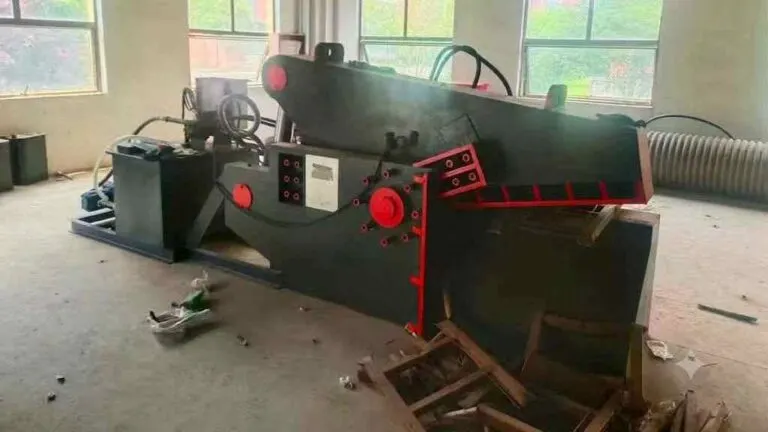
For heavy, long ferrous scrap such as HMS, H-beam, plate and rebar, a gantry shear is the right machine. For light, bulky or mixed scrap such as car shells, drums, white goods and cable, a shredder fits better, because it tears the material open and frees what is trapped inside. That is the short version of the gantry shear vs scrap metal shredder decision, and many busy yards end up running both.
HUAXIN builds both machine types. Our gantry shears come from the Tangshan plant in nine classes from 200 t to 2,000 t, and our HX-DS dual-shaft shredders from the Maanshan plant. The comparison below comes from specifying them for the same kinds of yards.
Gantry Shear vs Scrap Metal Shredder at a Glance
| Item | Gantry shear | Dual-shaft shredder |
|---|---|---|
| Action | One vertical blade stroke, 20–35 s cycle | Two counter-rotating shafts at low speed and high torque. |
| Best feed | HMS 1 & 2, plate, beams, pipe, rebar, bales (1,000 t and up) | Car shells, drums, white goods, light mixed scrap, non-ferrous. |
| Output | Cut lengths set on the PLC | Torn pieces, about 50–300 mm |
| Throughput | 2.0–30 t/h across 200 t to 2,000 t | 2–60 t/h across HX-DS800 to HX-DS2600 |
| Installed power | 22 kW up to 10×55 kW | 2×37 kW up to 2×400 kW |
| Non-ferrous liberation | Limited | Good, frees trapped plastic, rubber and copper |
Throughput and power figures come from our own product pages. Your real rate depends on the mix, the share of thick pieces, the loader cycle and whether the downstream conveyor or bucket ever makes the machine wait.
Cutting Versus Tearing
A scrap shear works by compression and a single cut. Material sits in a feed box, side compression packs it, a hold-down clamps it, and the blade passes the lower blade. Apart from the cut ends, the steel keeps its shape.
A dual-shaft shredder pulls material into interlocking hooked blades turning at 15–80 RPM. It tears in small bites. Hollow and thin-walled items collapse and open up. Solid thick plate is a different story: it is the wrong feed for a shredder and hard on its blades and gearboxes.
That single fact decides most cases.
What Goes Into Each Machine
Gantry shear feed
Long, stiff and heavy steel. Structural H-beam and I-beam, rail, thick pipe, plate up to the continuous limit of the class (25 mm at 200 t, 170 mm at 2,000 t), demolition rebar and HMS. Car bodies go on 400 t and larger machines. Compacted bales need 1,000 t or more.
Shredder feed
Volume, not weight. Depolluted car shells, steel drums, appliances, aluminium extrusions, copper wire bundles and light HMS. The shredder handles shapes a gantry box packs poorly, like a drum that springs back after compression.
Feed that suits neither machine well: sealed vessels, gas cylinders and anything under pressure. Both need pre-sorting for those.
Output Product and Who Buys It
Sheared pieces are sold as HMS 1 & 2 or plate-and-structural grades, cut to the length an EAF charging bucket or a foundry wants. If your buyer is a steel mill paying for prepared heavy melt, the shear produces exactly that. Our guide to HMS 1 and HMS 2 grades explains the length and thickness rules mills usually apply.
Shredded output is denser in a truck or furnace than loose light scrap. More important for many yards, it is liberated: steel, non-ferrous and non-metal parts come apart, so magnets and eddy current separators downstream can split them. That is where the value of mixed light scrap sits.
Power and the Site Supply
A shear’s electrical load peaks during the cut. Between strokes, while the pusher indexes and the loader refills the box, demand falls back. Even the 2,000 t class tops out at 10×55 kW, started in sequence to keep voltage dips off the transformer.
A shredder runs continuously under load. On the HX-DS range the installed drive spans 2×37 kW to 2×400 kW. A yard adding a large shredder to an existing shear site often needs a bigger supply. Shear models can also be ordered with generator or diesel drive.
Crew, Loading and Wear
One operator runs a gantry shear by remote, standing well clear of the blade while the PLC repeats the compression, clamp, cut and push sequence. A loader, typically an excavator on small sites or a grapple crane on large ones, fills the box. On a 200 t yard both jobs are often one person.
In our experience a shredder line needs a loader, an operator and someone watching the discharge conveyor and the sorted output piles. Wear differs too. Shear blades are four-edge reversible, so each blade is turned three times before it is replaced. Shredder blades and shafts wear continuously, and the HX-DS uses PLC current sensing to auto-reverse when tramp metal jams the rotors.
Layout and Downstream Equipment
A gantry shear is a single station. Scrap goes into a 4–8 m feed box at one end and cut pieces drop into a bucket, onto a conveyor or onto the ground at the other. Add stockpile space for incoming beams and outgoing HMS, plus reach for the excavator or grapple crane, and the layout is done.
A shredder is the first stage of a line. Behind it sit a discharge conveyor, usually a magnetic drum, and often an eddy current separator for aluminium and copper. Each needs floor space, power and someone to clear it. If you plan to sell mixed light scrap unsorted, much of the shredder’s advantage is lost.
Mistakes We See When Yards Choose
- Buying a shredder for a mill contract that pays for prepared heavy melt. The shear makes that product directly.
- Pushing thick plate and H-beam into a shredder because it is already running. Blade and gearbox wear rise sharply.
- Choosing a 200 t or 315 t shear for a stream that is mostly car shells. Those classes are not built for car bodies.
- Sizing either machine on the best hour at a demonstration instead of the slow end of the band.
When One Yard Runs Both
Many mid-size and large yards receive two streams that arrive mixed on the same trucks, and separating them at the gate is the first decision that makes either machine pay. Demolition jobs bring beams and rebar. Collection routes bring cars, drums and appliances. Each stream goes to the machine that fits it, and neither machine wastes hours on material the other would process faster, with less wear and a better price from the buyer.
A common pattern we specify:
- Sort at the gate into heavy long steel and light bulky scrap.
- Send heavy steel to the gantry shear for HMS and plate-and-structural lengths.
- Send light scrap to the shredder for liberation and separation.
- Route long pieces that jam a shredder infeed back to the shear for pre-cutting.
A yard taking 60–80 t/day of HMS and beam alongside a car-shell stream would pair a 630 ton gantry shear with a shredder sized to the light stream. Our note on scrap metal recycling line design covers how the stages connect.
Choosing by Your Scrap Mix
- Mostly beams, plate, rebar and HMS, sold to a mill: start with a shear from the hydraulic gantry shear range.
- Mostly car shells, drums and mixed light scrap with non-ferrous value: look at the dual-shaft scrap metal shredder range.
- Heavy steel plus some cars: a 400 ton gantry shear handles both, at 35–55 t/day.
- Two large streams of similar size: plan both machines, with sorting space between them.
Shear or Shredder FAQ
Can a shredder replace a gantry shear for heavy melting steel?
Not for thick plate and heavy sections. That material is hard on shredder blades and gearboxes, while a shear cuts it in one stroke at a length the mill accepts.
Can a gantry shear cut car bodies?
Yes, from the 400 t class upward. The side compression flattens the shell into the box first. You get cut steel, though, not liberated fractions.
Which uses more power?
Usually the shredder, because its rotors work under load for as long as material is fed. A shear’s load peaks during each cut and falls while the box is being refilled.
Is a dual-shaft shredder the same as a car fragmentizer?
No. The HX-DS is a low-speed, high-torque shear-type shredder, not a high-speed hammer mill. It pre-shreds car shells and bales rather than fragmenting them to fine size.
Send your intake mix and daily tonnage by stream through the contact page. HUAXIN engineers will recommend shear, shredder or both, with a written quotation within 48 hours.