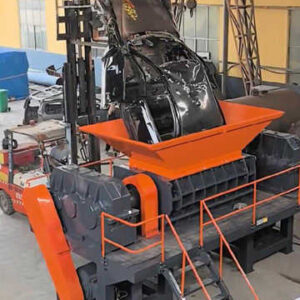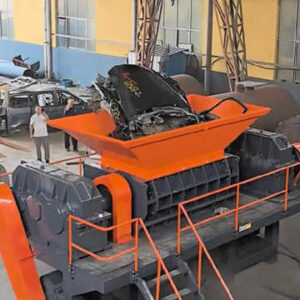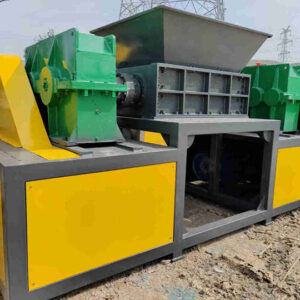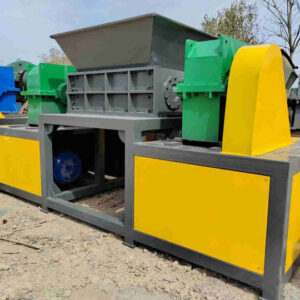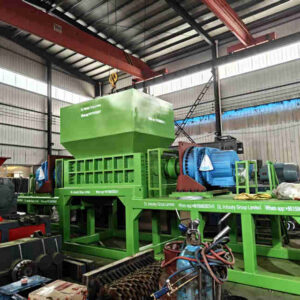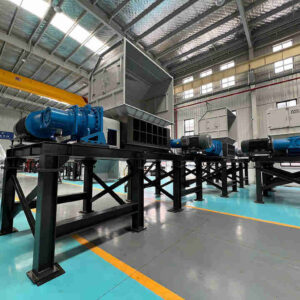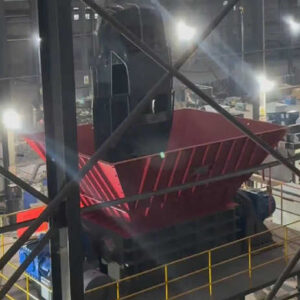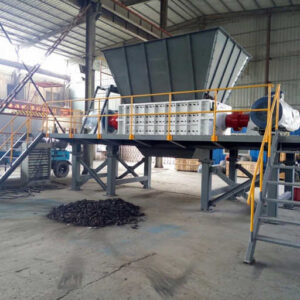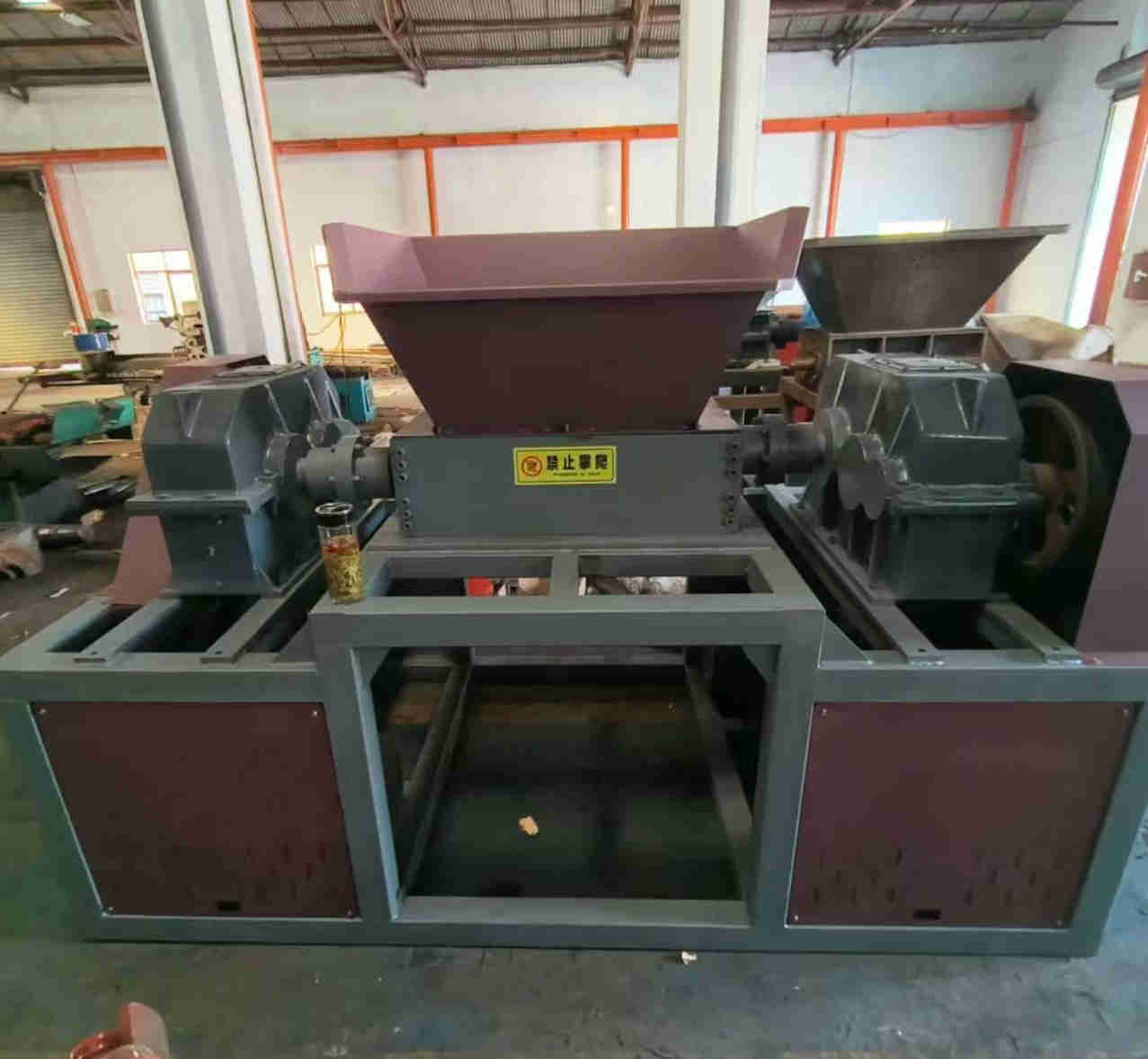
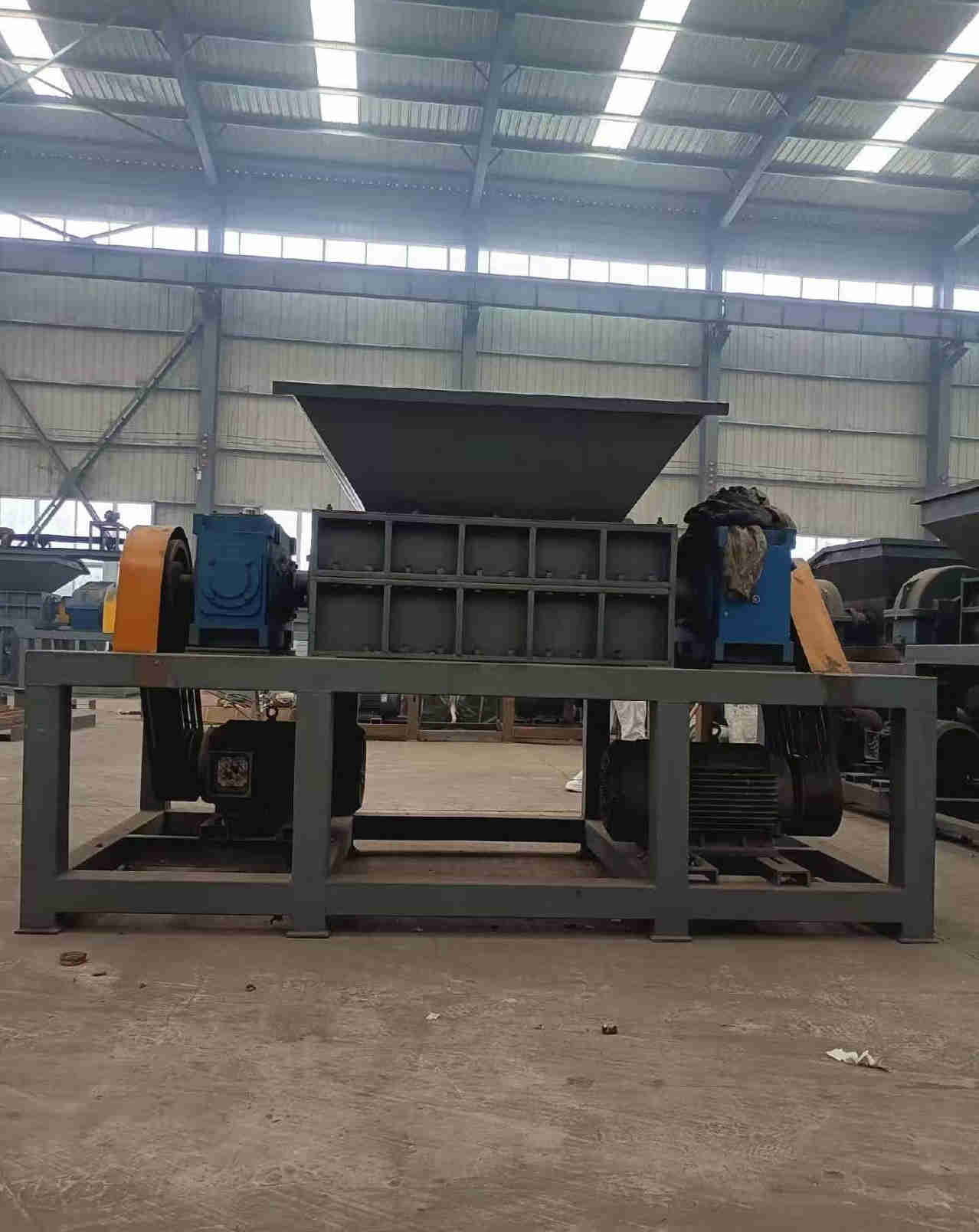
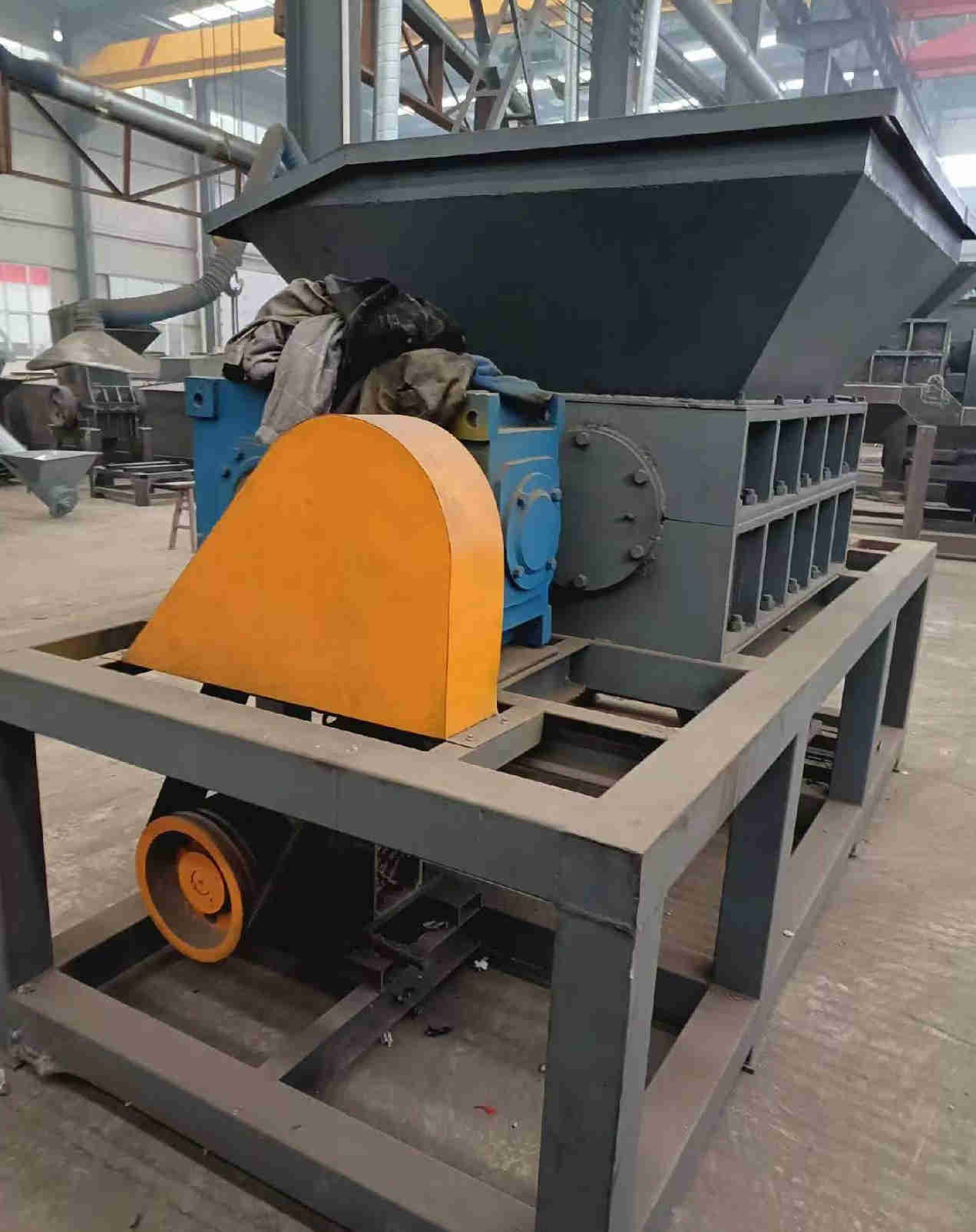
Scrap Metal Shredder (Dual Shaft) 2–6 TPH | HX-DS800
Workshop-grade dual shaft scrap metal shredder for first-time mechanised shredding. 2–6 tons per hour output from an 800 mm chamber — sized for fabrication shops, small yards and non-ferrous collection points rather than for tonnage.
Motor options: 2×37 kW / 2×45 kW / 2×55 kW, dual motor drive, electric, generator or diesel.
Blade options: M6V, H13 or Hardox 500, 300–550 mm diameter, dense-tooth, 7-tooth or 9-tooth profiles.
Built in-house: blade machining facility, mortise-and-tenon reinforced chamber frame, nylon-pin torque protection for the reducer and motors.
Best for: sheet offcuts, stamping scrap, aluminum profiles, copper and brass, thin-wall containers and drums.
Not for: whole car bodies or baled scrap — step up to the 1800 mm class or larger.
Send your scrap photos and thickness for a configuration recommendation and a free quotation within 48 hours.
Why Choose Huaxin
- Real Factory, 30+ Years Manufacturing Experience
- 24/7 Technical Support
- Customized Solutions Available
- Installation & Training Support
Description
2-6 TPH Scrap Metal Shredder for Sale – The Entry Machine for Workshops and Small Yards
The HX-DS800 is a 2 to 6 tons per hour dual shaft scrap metal shredder built for the buyer who is standing up a recycling operation for the first time. If your yard, workshop or collection point is still processing light scrap with shears and manual labour, this is the machine class where mechanised shredding starts — small enough to suit a modest site, priced for a first purchase, and configured around steel and non-ferrous material rather than tonnage.
Two counter-rotating shafts pull material into the chamber and tear it apart at low speed and high torque. That combination matters more at this size than anywhere else in the range: the HX-DS800 cuts sheet offcuts, aluminum profiles, copper scrap and thin-wall containers cleanly, without demanding the installed power a larger shredder would require.
Who the HX-DS800 Is Built For
This chamber class is specified by operations where the shredder is the first piece of powered processing equipment on site:
- Metal fabrication workshops generating stamping scrap, sheet offcuts and production waste that is currently sold loose or burnt off.
- Small scrap yards and collection centres taking in light mixed material — aluminum, copper, thin steel — at volumes that do not justify a bigger machine.
- Appliance and thin-wall recyclers breaking down white goods shells, empty drums and thin containers before separation.
- Non-ferrous specialists who need aluminum profiles, window frames and copper sheet reduced to a clean, dense, transportable fraction.
If your intake is already measured in truckloads of heavy structural steel, this is not your machine — the honest answer sits further up the range, and we will say so in the quotation.
Where the HX-DS800 Sits in the Shredder Range
The HUAXIN dual shaft shredder line covers 2 to 60 tons per hour across eight chamber classes, from the 800 mm HX-DS800 to the 2600 mm HX-DS2600. The HX-DS800 is deliberately the smallest: it exists so that a new operation does not have to buy capacity it cannot feed.
One point that surprises many first-time buyers: throughput figures on every model in this range are ranges, not fixed numbers. A shredder rated 2 to 6 tons per hour will sit at different points on that scale depending on what you feed it. Thin aluminum sheet moves through faster than heavy steel section; steady, continuous feeding produces more per hour than stop-start loading; and the motor package fitted — 2×37, 2×45 or 2×55 kW on this class — sets a ceiling that hard material will find quickly. We quote against your actual material, not the headline figure.
Key Specifications – HX-DS800
| Item | Specification |
|---|---|
| Model | HX-DS800 dual shaft scrap metal shredder |
| Throughput | 2–6 tons per hour (material-dependent) |
| Chamber length | 800 mm |
| Motor quantity | 2 motors |
| Motor power options | 2×37 kW / 2×45 kW / 2×55 kW |
| Rotating speed | 5–10 r/min |
| Blade diameter | 300–550 mm (configured to output size and material) |
| Blade materials | M6V, H13 or Hardox 500 |
| Blade hardness | 50–62 HRC options |
| Shaft material | 45# steel or 40Cr |
| Gearbox | ZQ series, ZSY series or planetary reducer |
| Input voltage | 380V / 400V / 415V / 230V, 50 Hz or 60 Hz |
| Power sources | Electric, generator or diesel engine |
| Certification | CE / ISO 9001 |
| Origin | Tangshan, China |
Capacity note: output depends on scrap type and thickness, feeding continuity, target discharge size and the rest of your line configuration. We size this machine against your material and feeding method, not against a catalogue maximum.
Applications – Where the HX-DS800 Earns Its Keep
The scenario that sells this scrap metal shredder most often is a fabrication shop paying to have its own offcuts hauled away. Shredding on site converts a disposal cost into a saleable, graded fraction, and the payback arithmetic at this size is short. Below are the four settings where the 800 mm chamber class does real work.
Fabrication shops and stamping plants
Sheet offcuts, punching waste and mis-cast pieces accumulate fast in a press shop. Running them through the HX-DS800 turns a heterogeneous heap into a uniform flake that fetches a better price than loose offcuts, and it removes the labour of sorting by hand before the truck arrives.
Scrap yards and collection points
Light mixed intake — aluminum window frame, copper offcuts, thin steel sheet, empty containers — is exactly what this chamber is sized for. Volume reduction before transport is the main gain: loose light scrap fills a trailer without filling its weight limit, and shredded material does neither.
Appliance and thin-wall recycling
White goods shells, drums, radiators and thin-wall containers need liberation more than they need force. The dense-tooth blade set opens up mixed thin material and releases the fractions that magnetic and eddy current separation downstream depend on.
Non-ferrous recovery points
Aluminum profiles, cast pieces and copper sheet all shred cleanly at this power level. Buyers selling into non-ferrous mills use the HX-DS800 to hit the size and cleanliness specification the mill demands, rather than negotiating down for oversized feedstock.
Materials the HX-DS800 Processes
Blade choice on a scrap metal shredder tracks material, and the table below reflects how we configure the HX-DS800 in practice for the streams that actually arrive at an 800 mm chamber.
| Material | Suitability | Typical configuration |
|---|---|---|
| Sheet offcuts, stamping scrap | Ideal — the core duty of this class | Dense-tooth blades, 2×37 kW |
| Aluminum profiles and castings | Ideal | Dense-tooth blades, 2×45 kW |
| Copper and brass offcuts | Good — size-dependent on cast pieces | H13 blades, 2×45 kW |
| Thin-wall containers and drums | Ideal when empty | Dense-tooth blades, 2×37 kW |
| Light steel plate under 3 mm | Good | M6V blades, 2×45 kW |
| Scrap rebar and small section | Limited — short lengths only | 7-tooth Hardox 500, 2×55 kW |
| Car bodies and whole shells | Not recommended | Step up to the 1800 mm class or larger |
| Baled or bundled scrap | Not recommended on this model | Requires the 2200 mm class and above |
Send photographs plus a rough thickness and we will tell you which blade steel and which motor option suits your mix on this scrap metal shredder — before you commit to a configuration.
How the HX-DS800 Works
Material is loaded into the hopper of this scrap metal shredder and drawn between two counter-rotating shafts carrying overlapping knife sets. The shafts turn slowly — 5 to 10 revolutions per minute — but the torque at the knife edge is high, so material is gripped and torn rather than struck. Dense-teeth open thin material quickly; for thicker pieces a 7-tooth or 9-tooth hook geometry takes a bigger bite per pass and pushes work toward the larger motor options.
Discharge falls onto a conveyor and out of the chamber. From there it goes wherever your line needs it: a stockpile for sale as-is, a scrap metal crusher for further size reduction, a magnetic separator to pull ferrous, or an eddy current separator to recover aluminum and copper. The shredder is the first stage; the rest of the line determines how much of the material value you actually capture.
Protecting the drivetrain
Unshreddable tramp material is a reality in light scrap — a stray bolt, a cast housing, a tool someone dropped in the bin. The nylon pin coupling between the gearbox and the drive is the sacrificial element: when torque spikes beyond its limit the pin shears, which costs a pin rather than a gearbox. On a machine this size that single detail is the difference between a five-minute change and a month-long parts wait.
Choosing the Right Configuration
By material
Aluminum, copper and thin steel are the natural duty of any 2 to 6 tons per hour scrap metal shredder, and they run comfortably on 2×37 kW. Mixed light material with a heavier fraction belongs on 2×45 kW. If your stream includes short rebar, small section or casting scrap, specify 2×55 kW and Hardox 500 knives — anything less will labour, heat the knives and consume blade life quickly.
By thickness
Under 2 mm sheet is the sweet spot. Between 2 and 4 mm, expect output to sit at the lower end of the 2 to 6 tons per hour band. Above 4 mm in volume, we will steer you to the 1000 mm chamber class rather than sell you a machine that underperforms.
By duty cycle
A workshop shredding its own waste runs single shifts with pauses — the 2×37 kW package is sized for that. A collection centre running eight hours continuously is better served by 2×45 kW, and any operation approaching two shifts should take 2×55 kW so the motors are never the constraint.
By available power supply
Standard supply is 380V, 400V, 415V or 230V at 50 Hz or 60 Hz. Where the grid is unreliable or the site has no service, the HX-DS800 can be driven by a generator set or a diesel engine — a genuine option at this power level, and one that disappears as machines get larger.
Why Buy the HX-DS800 from HUAXIN
Blade wear is the single largest consumable cost in scrap metal shredder ownership, and it is the item buyers can least easily verify. We make the knives. Blade wear is the largest consumable cost in shredding, and it is the one item most buyers cannot verify. We operate our own blade machining facility, so the steel grade on the drawing is the steel grade in the box — M6V, H13 or Hardox 500, heat treated to the 50–62 HRC band your material demands.
The frame is built for load, not for looks. The chamber is a mortise-and-tenon reinforced structure. It resists the cyclic loading that cracks thin-walled chambers, and it keeps shaft alignment under the side loads that light scrap actually produces.
The drive train is chosen, not defaulted. ZQ, ZSY and planetary reducers are all available on this class. For long-duty work we lean toward planetary units because efficiency loss shows up directly in your electricity bill.
You buy from the factory. There is no importer margin between the machineshop and your site, which matters most on a first machine where capital is tight and every spares order is a new expense.
One throat to choke. Shredder, conveyors, crusher, magnetic and eddy current separation can be supplied as one matched line, so interface dimensions, speeds and control logic are settled before the machine ships rather than on your site.
Options and Customization
- Blade profile and tooth count set to your scrap mix — dense tooth, 7-tooth or 9-tooth
- Blade diameter between 300 mm and 550 mm to hit your target discharge size
- Blade steel selection: M6V, H13 or Hardox 500
- Automatic lubrication for the bearings and shaft seals
- Hopper geometry and feeding structure adapted to how you load — grab, conveyor or manual
- Discharge conveyor length and height matched to your stockpile or downstream machine
- Electrical package, control panel and safety interlocks to your regional standard
- Generator or diesel drive in place of fixed electric supply
- Complete line integration with crusher, magnetic separation and eddy current separation
Footprint, Installation and Commissioning
This scrap metal shredder ships as a skid-mounted unit on a foundation flat. Civil work is limited to a level concrete pad and the power feed; no specialised pit or building is required, which is why this class suits workshops and yards that are adding a shredder to an existing site rather than designing a new plant around one.
We supply commissioning support with detailed drawings, electrical schematics and an assembly manual, and our engineers are available on site for start-up and operator training. Spares kits — knives, pins, seals, bearings — are quoted with the machine so the first year of wear parts is already in your stores rather than on a boat.
Honest Limits: When to Buy Something Else
Two situations make this the wrong machine.
The first is heavy structural intake. Girders, plate above 4 mm in volume, whole car bodies and baled material belong in larger chambers; forced through an 800 mm machine they cause knife damage, torque trips and throughput far below the rated band. The second is a growth plan that already exceeds 6 tons per hour on paper. If your three-year target is 12 tons per hour of mixed light scrap, buying the HX-DS1000 (3–10 tons per hour) today costs less than buying the DS800 now and replacing it later.
If neither applies, you have found the correct entry point. See the full dual shaft shredder range for the complete 2 to 60 tons per hour ladder, and ask us for a quotation against your own material data.
Frequently Asked Questions
What is the real throughput of the HX-DS800?
Anywhere between 2 and 6 tons per hour, and where a 2 to 6 tons per hour scrap metal shredder actually sits on that band depends on material, thickness, feeding continuity and discharge size. Thin aluminum fed continuously sits near the top; mixed light steel fed intermittently sits near the bottom. We quote the figure we expect for your material, not the catalogue ceiling.
Can it handle both ferrous and non-ferrous scrap?
Yes. Steel sheet, offcuts and thin plate go in alongside aluminum, copper and brass. On a dual shaft scrap metal shredder what changes with the material is the knife steel and tooth count, not the machine itself. Hardox 500 handles the abrasive and heavier fractions; H13 suits mixed copper and aluminum.
Can I shred car bodies with this machine?
Not as a production duty for this class of scrap metal shredder. Whole shells exceed what an 800 mm chamber can bite, and repeated attempts will damage knives and stress the drive. End-of-life vehicle work starts at the 1800 mm chamber class — on car bodies and shells we will recommend that class or larger rather than take the order.
What output size will I get?
Blade diameter and tooth spacing set the discharge size, and both are configurable from 300 mm to 550 mm on this model. Tell us what your downstream step needs — bale density, mill specification, separation efficiency — and we will specify knives to match.
Which motor option should I order?
2×37 kW for light, steady, single-shift work. 2×45 kW for mixed material over a full shift. 2×55 kW whenever rebar, small section or thicker pieces enter the stream. When in doubt, send material photographs and thickness and we will specify it.
Can you supply a complete recycling line?
Yes — a full line around this scrap metal shredder. Conveyors, a scrap metal crusher, magnetic separation, eddy current separation and a scrap metal baler for the non-ferrous fraction can all be matched to this shredder so the line arrives dimensionally compatible.
What power supply do I need?
380V, 400V, 415V or 230V at 50 Hz or 60 Hz are all standard on this scrap metal shredder. A generator set or diesel engine drive is available for sites without a stable grid connection.
How long do blades last?
That depends entirely on material abrasiveness and duty. Clean aluminum and copper give long intervals; mixed steel with sand and scale shortens them sharply. We quote a spares kit with the machine and can advise a regrind schedule for your specific mix.
Additional information
| Item | Small Scrap Metal Shredder Machine |
|---|---|
| Chamber Length | 800mm |
| Model | HX-DS800 |
| Chamber size | Customized according to diameter of the blade |
| Rotating speed | 5-10 r/min |
| Motor Quantity | 2 pcs |
| Motor Power | 2×37 kW / 2×45 kW / 2×55 kW |
| Gear box | ZQ series, ZSY series and Planetary Gear Reducer |
| Blade Quantity | Customized according to different materials |
| Blade Materials | M6V, H13, and Hardox 500 are available as options. |
| Blade Hardness Range | 50-62 HRC as options. |
| Blade Diameter | 300-550mm as options according to different output rate and materials |
| Blade Teeth | For soft materials, a dense-tooth configuration is used. |
| Shaft | 45# or 40Cr |
| Input voltage | 380V, 400V, 415V, 230V with 50HZ or 60HZ. |
| Power sources | Customized: electric, generator or diesel engine |