
The inclined shear has a simple pitch: angle the blade, let gravity assist the feed, and reduce the power the feeding system needs. It is a real idea with real applications, and it appears in enough European catalogs that buyers ask us about it honestly. This article is the honest answer: where the inclined design genuinely works, where it struggles, and how HUAXIN engineers both 30°–40° Gravity-Chute Inclined Shears (630T–1600T) and heavy compression-box gantry shears so you can match the right architecture to your yard. Across real-world industrial scrap metal shear installations, experience with our 1600 Ton Scrap Metal Shear (Q91-1600) confirms that proper material prep and hydraulic maintenance drive long-term profitability.
For the full design map, read the four-designs guide.
The Inclined Pitch
An inclined shear angles the cutting blade so that gravity helps move material through the cut. The claimed advantages are straightforward: lower feeding power because gravity does part of the work, a smaller footprint than a full gantry, and simpler operation for lighter duty. For consistent, free-flowing material those advantages are real.
The design shows up most in applications where material is consistent, and that qualifier is the whole story.
Where the Inclined Design Works
Consistent, free-flowing material. If your intake is uniform, the same profile, the same size band, week after week, gravity-assisted feeding does reduce the feeding power requirement and simplifies the machine. Operations with genuinely consistent material get a simpler machine at a lower power draw.
Footprint-constrained sites. The inclined design is typically more compact than a full gantry installation. Where floor space is the binding constraint and the material is consistent, that compactness matters.
Lighter duty cycles. For intermittent rather than continuous duty, the inclined design’s simpler structure is easier to live with.
Where It Struggles
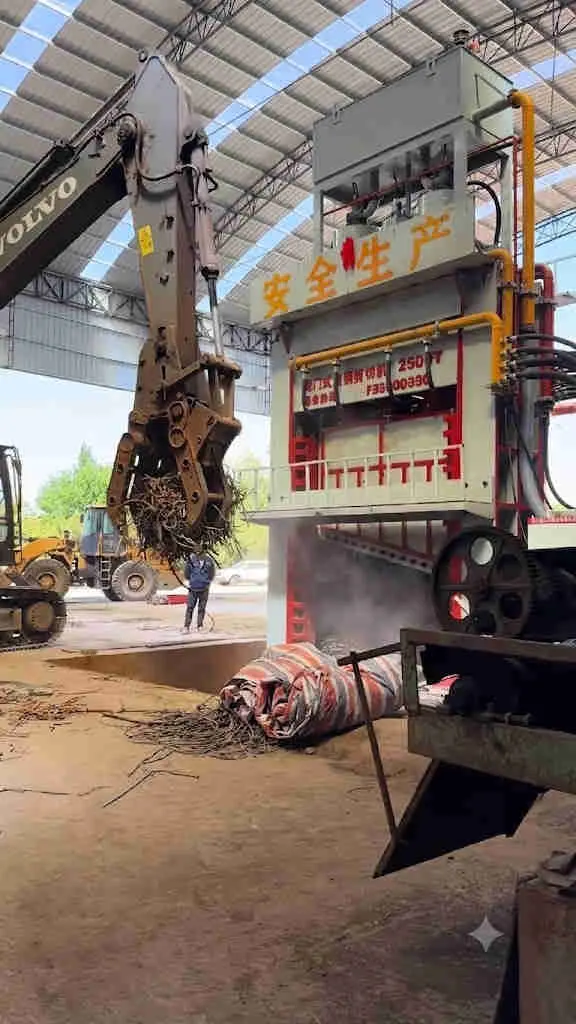
Irregular heavy scrap. Gravity feeds what gravity can move. Irregular heavy pieces, the material most yards actually receive, do not flow; they lodge, and a lodged piece on an inclined plane is a jam with the material’s weight behind it. The gantry’s hydraulic feed advances material to the blade regardless of shape, which is why heavy irregular feed is gantry territory.
Force and reaction. The inclined geometry changes how reaction force travels through the frame, and the design’s force ceiling sits below the gantry’s at the top of the range. Continuous heavy duty. HMS as a daily diet, plate at the heavy boundaries, is where the portal frame’s force distribution decides the machine.
Cut consistency on variable material. Gravity-assisted feeding is consistent when the material is. Variable material produces variable feed behavior, and variable feed produces variable cut length, the opposite of what a specification buyer pays for.
Why HUAXIN Builds Both Designs
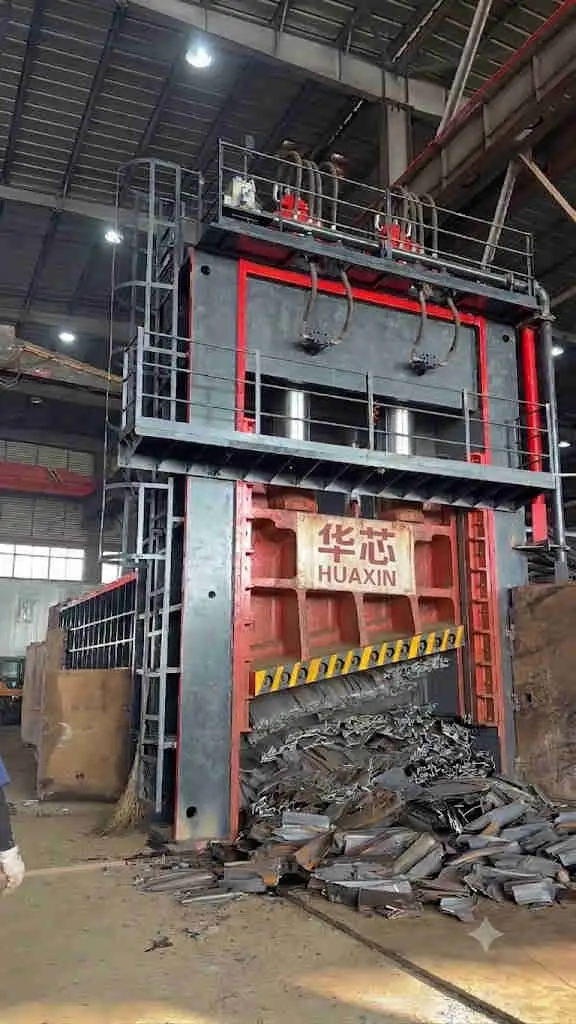
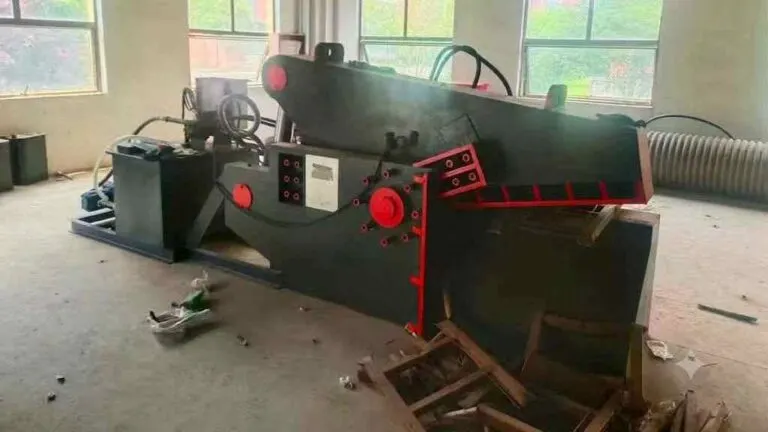
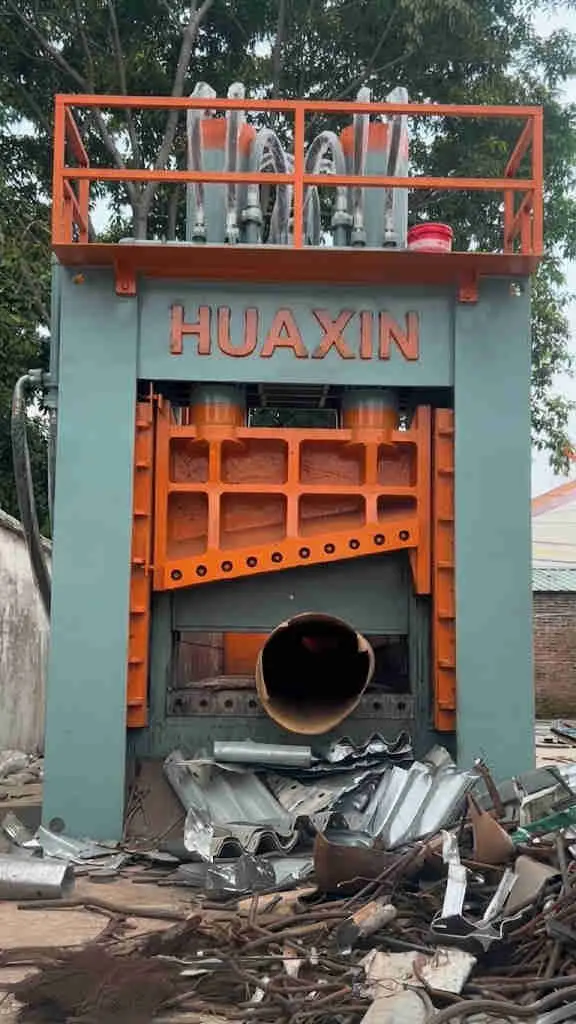
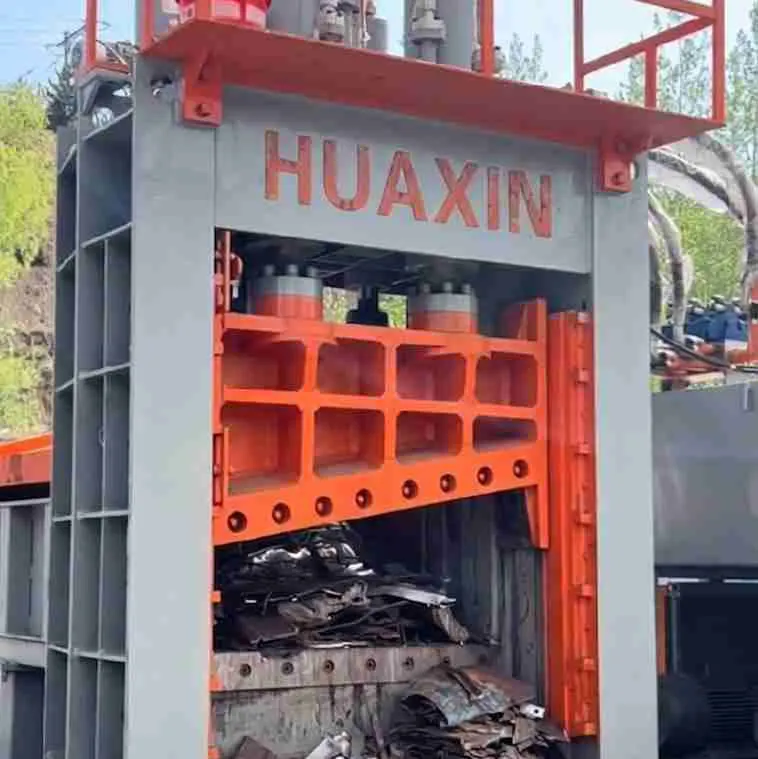
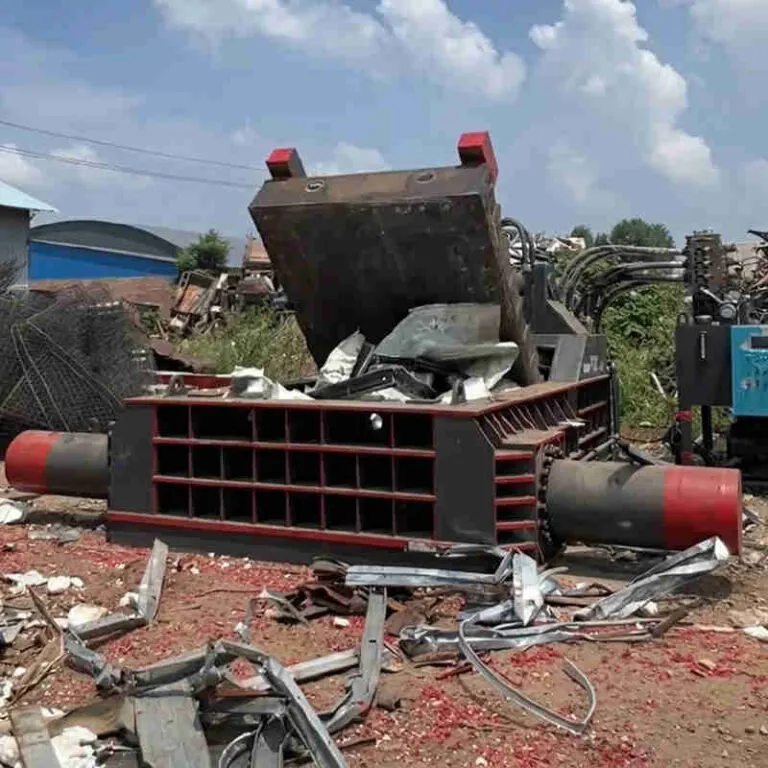
Our position is a material position. HUAXIN builds both: the Q91 gantry range from 200 to 2000 ton for heavy plate, continuous HMS, demolition feed and mixed sections, and the NS inclined scrap metal shear from 630T to 1600T for long, free-flowing material such as rebar bundles, pipe, H-beams and rail.
We would rather build the machine your material needs than the machine the catalog lists. If your intake is long and free-flowing, the inclined design may be the right machine and we will say so at quotation; if it is irregular and heavy, the gantry answers.
The Comparison in One Table
| Dimension | Inclined shear | Gantry shear |
|---|---|---|
| Feeding | Gravity-assisted | Hydraulic feed, excavator-loaded |
| Best material | Consistent, free-flowing, lighter | Irregular, heavy, variable |
| Force ceiling | Lower at top of range | Highest in category (200–2000 ton in our range) |
| Continuous duty | Intermittate-oriented | Specified against declared shift pattern |
| Cut consistency | Consistent when material is | Uniform on PLC presets regardless |
For the operations the gantry fits, the full range maps every class from 200 to 2000 ton, and the buying guide covers the specification conversation.
The Reaction Force Question
The engineering reason the gantry carries higher force ratings is worth stating plainly, because it is the whole argument. Every cut generates a reaction force equal to the cutting force, and the structure has to carry it. A portal frame anchored in concrete distributes that reaction across four columns and an upper beam, the load spreads, and the structure can be rated for sustained heavy cutting. An inclined or open frame carries the reaction through a different path, and the force ceiling follows the structure.
This is why “500 ton” on an inclined listing and “500 ton” on a gantry listing are not the same specification. The number is the hydraulic system’s capability; the structure decides how much of it reaches the blade, shift after shift, without deflection that shows up as a drifting cut. Read the frame, then the number.
Where the Inclined Design Earns Its Place
None of this makes the inclined design a bad machine. It earns its place on consistent, free-flowing material such as long rebar, pipe, beams and rail, where the feeding power saving is real and the jam risk never materializes because the material flows. Operations with that intake, uniform profile, loose or lightly bundled, week after week, get a simpler machine at a lower power draw, and the design’s advantages are genuine for them.
We build both because yards receive both kinds of material. Irregular heavy feed answers with a hydraulic feed and a portal frame; long, consistent sections answer with a gravity chute. Declare your intake at quotation and we will compare the two against your heaviest routine pieces.
The Duty Row, Again
One more axis separates the designs, and it is the one buyers check least: the duty basis. A gantry build is quoted against a declared shift pattern, two shifts and three shifts are different builds, and the declaration is written into the quotation because frame, hydraulics, cooling and wear strategy all follow it. Many inclined listings do not state a duty basis, and a duty basis that is not stated is a duty basis that has not been engineered. When an inclined listing quotes a tonnage, ask what shift pattern the rating assumes and what material it was measured on. The answers tell you whether the machine is a production tool, and at heavy duty that question is the whole decision.
The Yard That Switched
A short case, because it is common. An operation ran an inclined machine on consistent foundry returns for years, the material flowed, the gravity feeding saved power, and the design was right. Then the supply changed: the foundry closed, the intake became demolition material, and the inclined machine spent its shifts jamming on irregular feed. The machine had not changed; the material had. The operation moved to a gantry, not because the inclined design was bad, but because the material that defines a yard’s hardest jobs had arrived. The lesson is not about designs, it is about re-running the feed-shape test whenever the intake changes, because a machine specified against last year’s material is a machine fighting this year’s.
The Material Changed, Not the Machine
The clearest lesson from the inclined-versus-gantry comparison is that machines are specified against material, and material changes. A design that was right for a decade of consistent feed becomes wrong the quarter the intake turns irregular, not because the machine degraded, but because the specification it was built against stopped describing the operation. The discipline that survives this is the feed-shape test re-run whenever the intake changes, and the willingness to have the design conversation again. The machine that was right for last year’s material is a machine fighting this year’s.
Engineering & Field FAQ: Inclined Shear vs. Gantry Shear: Gravity Chute vs. Compression Box Selection Guide
Is the inclined shear a bad machine?
No, it is a machine for consistent, free-flowing, lighter material and footprint-constrained sites. It is the wrong machine for irregular heavy feed, which is what most yards receive.
Does HUAXIN build an inclined shear?
Yes. The NS series covers 630T to 1600T for long free-flowing scrap; the Q91 gantry range covers 200T to 2000T for irregular heavy feed.
What material suits the inclined design?
Consistent profile, consistent size band, free-flowing, week after week. If that describes your intake, say so at quotation and we will discuss it honestly.
Does gravity feeding really save power?
On consistent material, yes, that is the design’s genuine advantage. On irregular material the saving disappears into jams and pre-cutting.
What gantry class replaces an inclined application?
It depends on the material. Light consistent feed at workshop volume may suit the Q91-200; heavier feed scales up the range. The recommendation comes back in writing within 48 hours of your material profile. The design serves the material, and when the material changes the conversation reopens, that is not a failure of the first decision, it is the discipline working. Run the feed-shape test whenever the intake changes, and the design conversation stays honest for the life of the operation rather than the life of the purchase.
Need help sizing cutting force, blade length, and hydraulic power for your throughput? Compare full machine parameters on our 1600 Ton Scrap Metal Shear (Q91-1600) page, review our Q91 & NS scrap shear hub engineering hub, or contact HUAXIN’s Tangshan engineering team with your feedstock photos and target daily tonnage.
One Comment