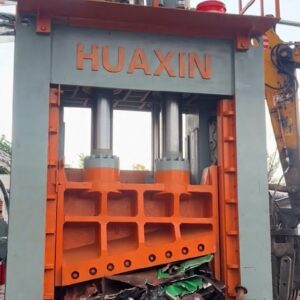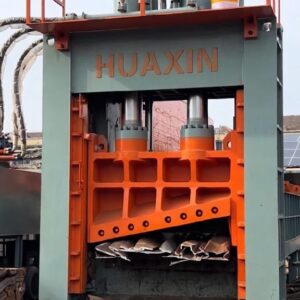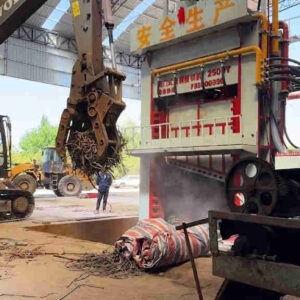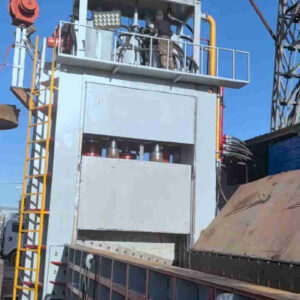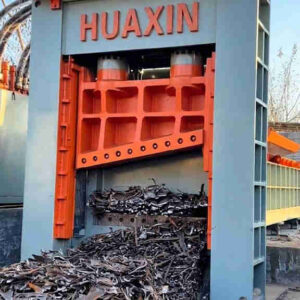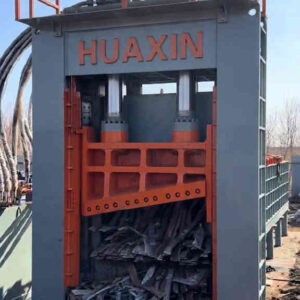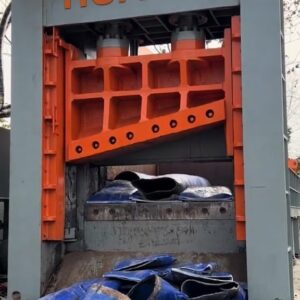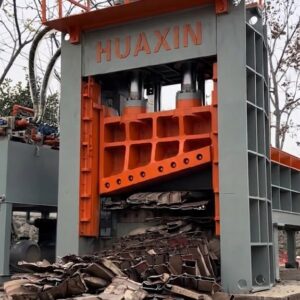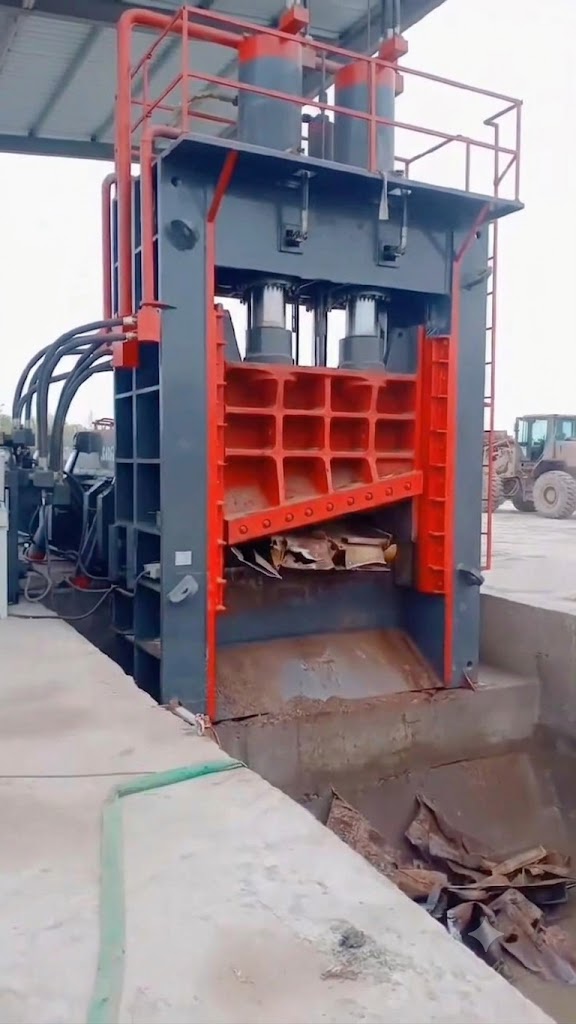
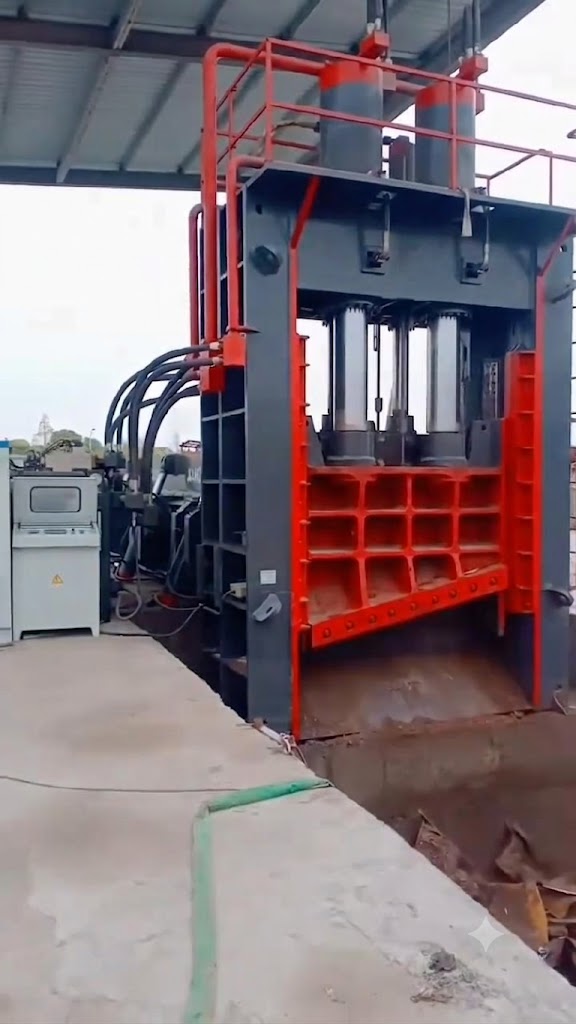
Hydraulic Gantry 1000 Ton Scrap Metal Shear Machine – Q91-1000
The Q91-1000 is a 1000 Ton scrap metal shear for high-volume plants and small steel mills running 100–120 tons per day, and the first model in the Q91 range specified to cut baled scrap. Bale Cutting Rated: bales plus heavy sections on the same shift, on one machine. Continuous HMS Duty: heavy mixed ferrous all shift long. Cuts 100 mm Plate Continuously: up to 130 mm occasionally. Cuts Rebar: loose or bundled, concrete-adhered sections included. Long Blade: 1,800–2,000 mm for oversized material. Matches for large scrap recycling plants, small steel mills and bale-heavy intake operations CE / ISO 9001 certified. Send your material mix, bale share and daily volume for a quotation within 48 hours.
Why Choose Huaxin
- Real Factory, 30+ Years Manufacturing Experience
- 24/7 Technical Support
- Customized Solutions Available
- Installation & Training Support
Description
1000 Ton Scrap Metal Shear for Sale – High-Capacity Shearing With Bale Cutting
The Q91-1000 is a 1000 Ton hydraulic scrap metal shear for operations that work at a scale where mid-tonnage machines stop making sense: high-volume intake, furnace-direct charging, and — from this tonnage class up in the Q91 range — the ability to cut baled scrap. If your plant takes in light scrap that arrives as bales from a baler, or runs bale-plus-heavy-section intake, this is the first model in the range specified to process both.
Who the Q91-1000 Is Built For
This class is specified by plants with large, steady throughput and a bale or heavy-section problem:
- Large-scale recycling plants and small steel mills running 100 to 120 tons of sized output per day.
- Yards that take light scrap as bales and need to re-size bales for furnace charging, not sell them as-is.
- Operations combining bale intake with heavy sections on the same shift, which is what separates this class from the demolition tiers below it.
Buyers at this scale are usually upgrading from a two- or three-scrap metal shredder line, or from a mid-tonnage shear that is now the bottleneck in the plant rather than the solution.
Why Bale Cutting Starts at This Tonnage
A baled scrap block is a dense, tightly compressed package held together by its own binding wires. Cutting one demands sustained force through a thick cross-section and a frame that can take the shock when the cut finally breaks — force levels and frame margin that the 400T and 500T classes are not specified for. That is why bale cutting in the Q91 range begins at the 1000 ton scrap metal shear and continues through the 1250T, 1600T and 2000T models, while the smaller classes are deliberately not rated for it. Buyers whose intake is mostly loose heavy material rather than bales will find the 630 ton continuous-duty class the better match.
Baled Scrap Capability – What the Q91-1000 Adds
What Bale Cutting Means in Practice
Baled light scrap is economical to transport and store, but a furnace wants charge at a consistent size, not an intact bale. The Q91-1000 takes bales from the intake pile and cuts them into furnace-ready charge on the same machine that handles the plant’s heavy sections. For a plant taking a mixed intake of bales plus structural material, that means one machine instead of a shear plus a separate bale-breaking line.
Where Bale Cutting Belongs in the Range
| Model | Baled scrap | Continuous HMS | Daily capacity |
|---|---|---|---|
| Q91-500 | No | No | 45–60 t |
| Q91-630 | No | Yes | 60–80 t |
| Q91-1000 (this model) | Yes | Yes | 100–120 t |
| Q91-1250 / 1600 / 2000 | Yes | Yes | 160–300 t |
Two capabilities, two tiers: continuous HMS from 630T upward, bale cutting from 1000T upward. If your intake is bale-heavy, the larger tonnage is not a luxury — it is the specification.
Key Specifications – Q91-1000 1000 Ton Gantry Shear
| Item | Specification |
|---|---|
| Model | Q91-1000 Hydraulic Scrap Metal Shear – gantry type |
| Shearing force | 1000 ton |
| Blade length | 1,800 mm or 2,000 mm |
| Motor power | 3×45 kW or 4×45 kW |
| Cycle time | 20–35 seconds per cut |
| Daily capacity | 100–120 tons/day, material-dependent |
| Feeding tank length | 6 m / 6.5 m / 7 m |
| Baled scrap capability | Yes — specified for this model class |
| Power source | Electric grid, diesel generator, or on-site power station |
| Input voltage | 380V / 400V / 415V / 230V, 50 Hz or 60 Hz |
| Blade material | H13 or M6V tool steel, 56–62 HRC, four-sided reversible |
| Automation | PLC full-auto, remote control, emergency stop, overload protection |
| Certification | CE / ISO 9001 |
| Origin | Tangshan, China |
What the Q91-1000 Cuts – Bales, Heavy Plate and Continuous HMS
Material Duty Ratings
| Material | Q91-1000 duty rating |
|---|---|
| Baled scrap | Specified capability — bales cut to furnace-ready charge size |
| HMS 1 & 2 | Continuous duty |
| Steel plates | Up to 100 mm continuously; up to 130 mm occasionally |
| H-beams / I-beams | Light through heavy sections, including deformed members |
| Angle and channel steel | Light through heavy structural profiles |
| Steel pipes | Single or bundled, thick-wall included |
| Rebar | Loose or bundled |
| Car bodies | Flattened or pre-treated shells |
| Mixed ferrous scrap | Large-plant intake including mill returns |
Capability Boundary
- Continuous duty: bales, HMS 1 & 2, plate to 100 mm, heavy sections — all shift long, at 100 to 120 tons a day.
- Occasional duty: plate up to 130 mm. Beyond that, size up.
- Step up instead: if your target passes 120 tons/day, or plate above 130 mm is a daily feature, the 1250 ton heavy-plate class is the tier to size to.
Frame, Blades and Bale Duty
Bales and heavy plate both load the machine in ways light scrap does not: the cut breaks suddenly, and the energy that release carries has to go into the frame rather than the hydraulics. The Q91-1000 uses a stiffened gantry structure, oversized cylinders and premium valve blocks specified for that shock loading, with a 6 to 7 metre feeding tank so long sections and large bales feed without pre-cutting. Cutting edges are H13 or M6V tool steel at 56–62 HRC with four usable faces. On a bale-plus-heavy-section mix, regrind intervals sit between clean HMS duty and abrasive demolition duty; we state the interval for your mix in the quotation.
Applications – Rebar, Demolition Intake and Bale Breaking
The Q91-1000 is specified for plants whose intake arrives in three forms at once: rebar-reinforced demolition material, heavy structural sections and bales. One 1000 ton scrap metal shear processes all three in a single flow — cutting rebar to charge length, re-sizing bales for the furnace, and taking plate and sections the smaller classes were not built to hold. The application list below covers where this class is most often installed.
Cutting Rebar from Demolition Intake
Reinforcing bar arrives loose, in bundles, or still attached to concrete from dismantling work. The Q91-1000 cuts rebar in all three forms, sizing it to your furnace charge length instead of leaving pre-cutting to a torch crew. Slabs and frames that hold the bar in concrete are taken at the machine’s rated capacity, which is where a smaller shear’s throughput collapses.
Bale Breaking and Re-Sizing at Volume
Light scrap compressed into bales is cheap to move and expensive to feed: a furnace wants consistent charge, not an intact block. This machine cuts bales to furnace-ready size on the same frame that takes the heavy material, so a bale-heavy yard runs one line instead of a shear plus a separate breaking station.
Charge Preparation at Small Steel Mills
Mills and foundries working at 100 to 120 tons a day use this class to size rebar crops, HMS 1 & 2 and plate into uniform charge before the furnace door. Chamber length and cut consistency are configured to the furnace, so sized pieces drop straight into the charge bucket without re-handling or a second pass.
Mixed Demolition and Dismantling Contracts
Contractors running deconstruction sites deliver material that is never one thing: rebar-reinforced slabs, structural steel, pipe and the occasional plate. The continuous-duty rating on HMS and the bale capability keep intake that varies through the shift inside one specification, so the day’s productivity stops depending on how clean the load was.
Shearing Cycle – How the Q91-1000 Works
Material drops into the tank; the side rams clamp and compress against the rear support; the blade descends and sizes the material to the chamber length; sized pieces discharge while the blade returns. Cycle time is 20 to 35 seconds per cut, with bales and heavy sections at the upper end. For furnace charging, chamber length and cut consistency are the numbers that matter — both are configured from your furnace requirement.
Power Supply, Control and Safety
Motor packages are 3×45 kW or 4×45 kW, selected against your intake mix and throughput target, with voltage configured to your switchboard at 380V, 400V, 415V or 230V, 50 Hz or 60 Hz. At this installed power the supply is a real engineering item: we size the supply, cabling and protection against the final configuration before shipment. A PLC runs the cycle sequence; the operator works from a remote station clear of the shear zone; and emergency stop and overload protection both react to abnormal hydraulic conditions. Grid, diesel generator and on-site power station configurations are all available.
Shipping, Commissioning and After-Sales
The Q91-1000 ships as separate heavy items — gantry frame and shear head, cylinder packages, hydraulic power unit and electrical cabinet — packed for container or flat-rack sea freight, with a packing list and lifting plan issued against your receiving crane capacity. Installation drawings and a commissioning checklist come with the machine, and an engineer can attend for start-up and operator training, including bale-handling practice. Spares cover blades, seals, valve components and hoses; the blade family is common across Q91 tonnages, so stock held for this machine also serves the rest of the range.
Why Large Plants Choose HUAXIN
- Bale cutting specified, not improvised. From 1000T up, bale capability is a rated specification with the frame margin to match, not an afterthought.
- Throughput quoted honestly. Capacity figures are stated per material mix, and we model the bale share rather than assuming loose scrap.
- Supply engineering included. At 3×45 kW and above, the power package is sized with your switchboard, not against it.
- One blade family across the range. Because one blade family covers the tonnage classes, plant-scale spares stocking stays simple.
FAQ – 1000 Ton Scrap Metal Shear
Can the Q91-1000 cut baled scrap?
Yes. Bale cutting is a specified capability from the 1000 ton class upward in the Q91 range, and the Q91-1000 cuts bales into furnace-ready charge on the same machine that handles heavy sections. The classes below it — including the 500T demolition model — are deliberately not rated for bales.
What bale sizes can the Q91-1000 handle?
It depends on the bale density, dimensions and wire binding, which vary by baler. Send us your bale specification and the share of your intake that arrives as bales, and we will confirm suitability and configure blade length, chamber length and motor package accordingly — including telling you if a larger tonnage is the honest answer.
Is the Q91-1000 better than running a 630T with a separate bale line?
If bales are a significant share of intake, usually yes: one machine, one power package, one operator and one maintenance point, with the bale work and the heavy-section work done on the same shift. If your bale share is small and your intake is heavy ferrous, the 630 ton continuous-duty shear remains the better-balanced choice.
What plate thickness can the Q91-1000 cut?
Up to 100 mm continuously and up to 130 mm occasionally, alongside continuous HMS 1 & 2 and baled scrap. Daily plate above 130 mm points to the 1250 ton class and above.
What power supply does a 1000 ton class machine need?
Standard motor packages are 3×45 kW or 4×45 kW at 380V, 400V, 415V or 230V, 50 Hz or 60 Hz. At this installed power we size the supply, cabling and protection against the final configuration before shipment, and we can configure for a diesel generator or on-site power station where grid power is limited.
What data do you need to size a 1000T line?
Material mix with the bale share, heaviest plate or section, target tons per day, feeding method, site power available, and the furnace or end-use. Each of those points moves one of blade length, tank length, chamber length, motor package or automation level.
Can the Q91-1000 cut rebar?
Yes. Rebar is cut loose or in bundles, and sections that hold the bar in concrete are handled within the machine’s rated duty. Send your material profile and we confirm blade length and chamber length so rebar discharges at your charge size without a torch crew in the loop.
What applications is the Q91-1000 used for?
Rebar cutting from demolition intake, bale breaking and re-sizing, charge preparation at small steel mills and foundries, and mixed dismantling contracts — any operation combining rebar, heavy sections and bales at 100 tons a day or more.
How much does a 1000 ton scrap metal shear cost?
At this tonnage a quotation is an engineering exercise: blade length, bale share, chamber length, motor package and plant power all move the number. We quote EXW factory-direct with a line-by-line breakdown, and we will say plainly when a smaller class covers the duty. Send your material mix, bale share and daily volume for the quotation within 48 hours.
Sizing a high-capacity line? Send your material mix, bale share, daily volume and site power details for a configuration recommendation and quotation within 48 hours. Review the full scrap metal shear range or compare the 500 ton demolition class.
Additional information
| Machine Type | Hydraulic Scrap Metal Gantry Shear Machine |
|---|---|
| Model No. | Q91-1000 |
| Shearing Force | 1000Ton |
| Material Processed | Light, Medium and Heavy Scrap Metal |
| Application | Scrap Metal Recycling |
| Industry | Scrap Recycling (large-scale) |
| Automation | Full Auto |
| Drive System | Hydraulic |
| Brand | HUAXIN |
| Origin | China |
| Certification | CE ISO9001 |