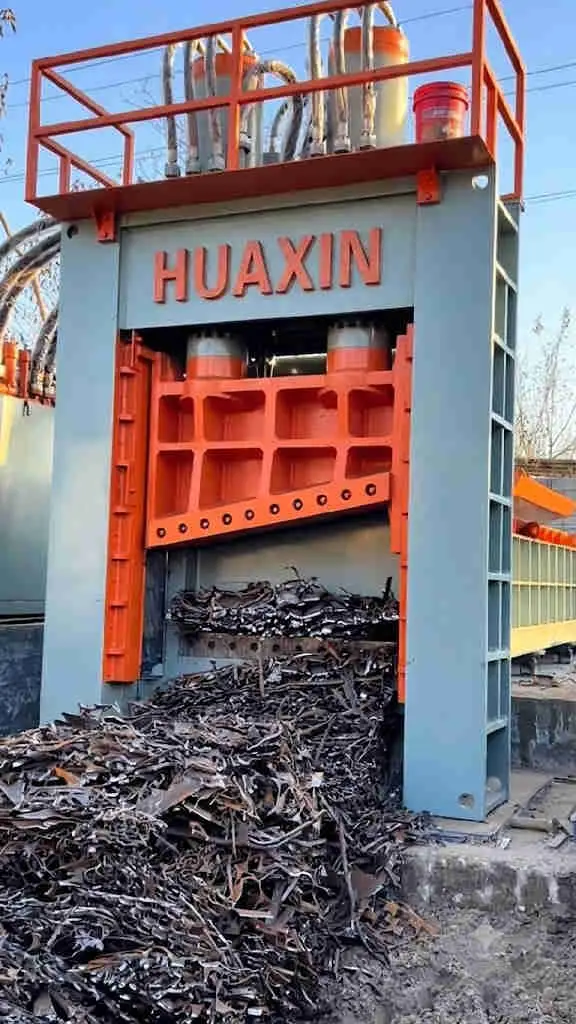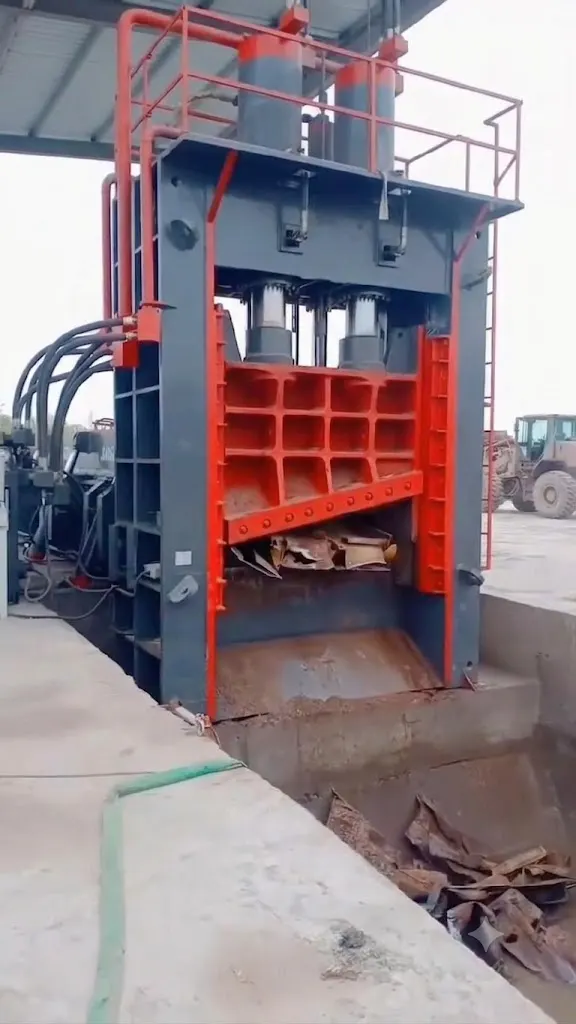
In heavy scrap metal densification and furnace feedstock logistics, deploying a high-efficiency high density metal baler directly governs cycle speed, shipping container payload, and melting economics. For recycling yards operating the Y81K-500 Heavy-Duty Scrap Metal Baler manufactured by Huaxin Co., Ltd., optimizing compression kinematics, hydraulic pressure staging, and chamber wear protection is essential to producing tight, high-density dealer bundles that command premium mill pricing.
The Physics of Bale Density: Loose Scrap vs. Compressed Bundles
In modern steelmaking, the physical density and dimensional uniformity of incoming scrap bundles are primary variables governing the thermodynamic efficiency of Electric Arc Furnaces (EAF) and induction melting operations. Steel mills routinely assign premium pricing to scrap dealers capable of supplying certified high-density bales, while penalizing or rejecting loosely packed, oversized bundles.
Unprocessed loose scrap steel exhibits an extremely low bulk density, typically between 0.25 t/m³ and 0.45 t/m³ (15 to 28 lbs/cu ft). Transporting loose scrap in 40-foot high-cube (40HQ) containers causes them to “cube out” at barely 12 to 14 tons. Industrial balers manufactured by Huaxin apply progressive three-side hydraulic force to compress ferrous feedstocks into ultra-dense packets achieving 1.8 t/m³ to 2.4 t/m³ (112 to 150 lbs/cu ft), reaching legal 28.5-ton container weight limits with ease.
Bale Dimension Engineering Matrix: Matching Size to Furnace Crucibles
| Bale Cross-Section | Typical Weight | Machine Model | Primary Feedstock | Target Melting Application |
|---|---|---|---|---|
| 300 × 300 mm (11.8 × 11.8 in) | 40–90 kg (88–198 lbs) | Y81F-125 / Y81F-160 | Non-ferrous, UBC, clean copper, light sheet | Small induction crucibles, copper smelters |
| 400 × 400 mm (15.7 × 15.7 in) | 100–220 kg (220–485 lbs) | Y81F-200 / Y81F-250 | Stamping skeletons, light iron, extrusions | Foundry induction furnaces, mini-mills |
| 600 × 600 mm (23.6 × 23.6 in) | 450–900 kg (992–1,984 lbs) | Y81K-500 / Y81K-630 | Structural steel trim, rebar, auto parts | Large EAF steelmaking plants, export terminals |
| 800 × 800 mm (31.5 × 31.5 in) | 1,000–1,800 kg (2,204–3,968 lbs) | Y81K-800 / Y81K-1000 | Heavy plate offcuts, sheared HMS, demolition | Integrated steelworks, 100-ton+ EAF shops |
Upstream Sizing Workflows: Shearing and Shredding Integration
Maximizing Compaction Throughput: To eliminate chamber bridging when baling heavy structural shapes or long angle iron, pre-cutting oversized steel with an upstream hydraulic scrap metal shear boosts baler packing density and line throughput by 20% to 30%.
Similarly, running tangled light sheet skeletons through an upstream dual-shaft scrap metal shredder pre-fragments material into compact ribbons, while painted automotive panels can be processed in a scrap metal crusher for surface scale removal prior to furnace delivery.
Specific Face Pressure and Eliminating Bale Spring-Back
High-tensile automotive steels (such as advanced high-strength steels, AHSS) possess severe elastic memory. If compressed with inadequate specific ram face pressure, bales expand and disintegrate upon chamber ejection. Huaxin balers ensure specific ram face pressure exceeds 4.5 MPa (650 PSI) for light iron and 6.5 MPa to 8.5 MPa (940 to 1,230 PSI) for high-tensile stamping trimmings, backed by a programmed 3-to-5 second hydraulic dwell time that guarantees permanent plastic deformation.
Ready to configure your processing line or request factory-direct FOB/CIF pricing? Review full technical specifications on our Y81K-500 Heavy-Duty Scrap Metal Baler product page, explore our complete high density metal baler machinery catalog, or contact our technical sales engineering team with your scrap material sample specifications and daily tonnage targets.