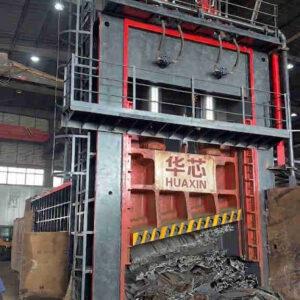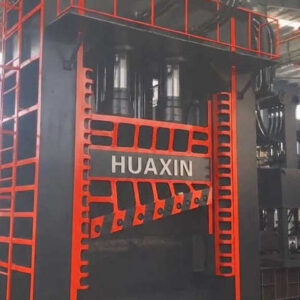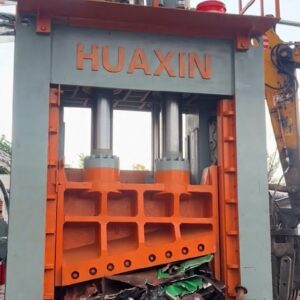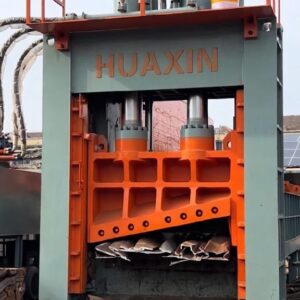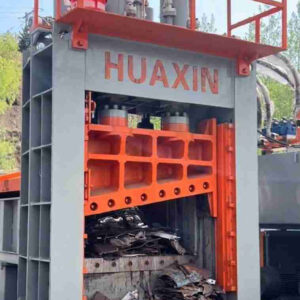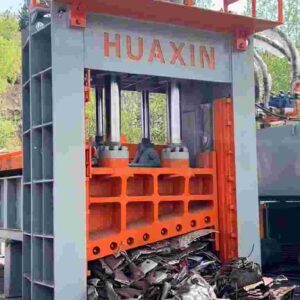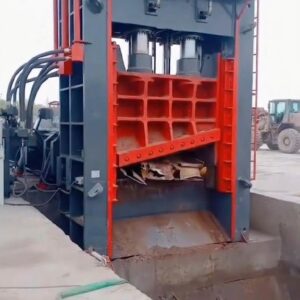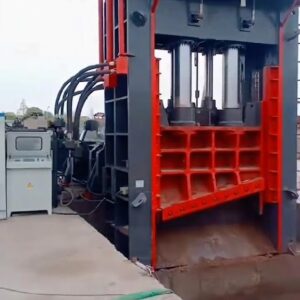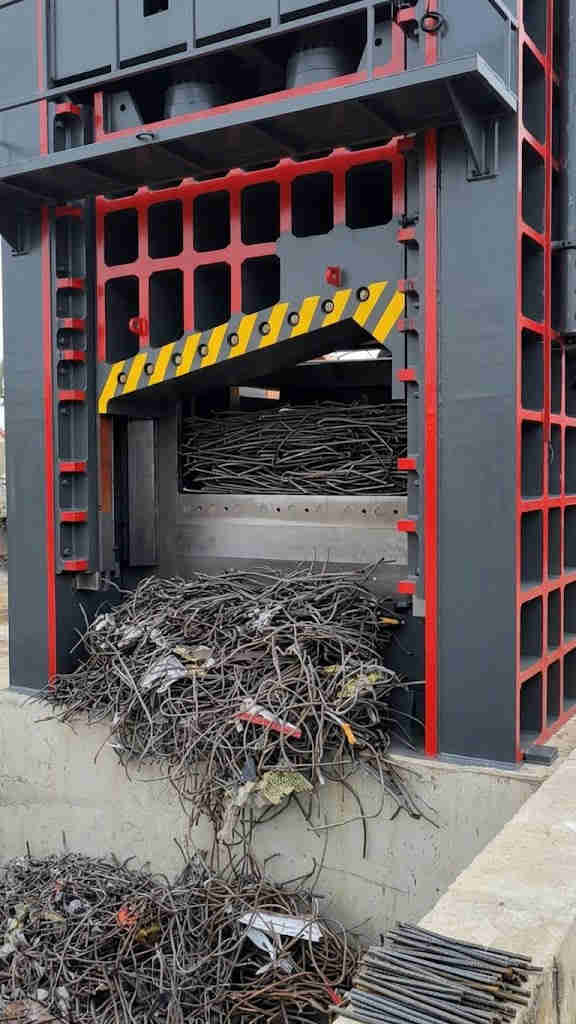
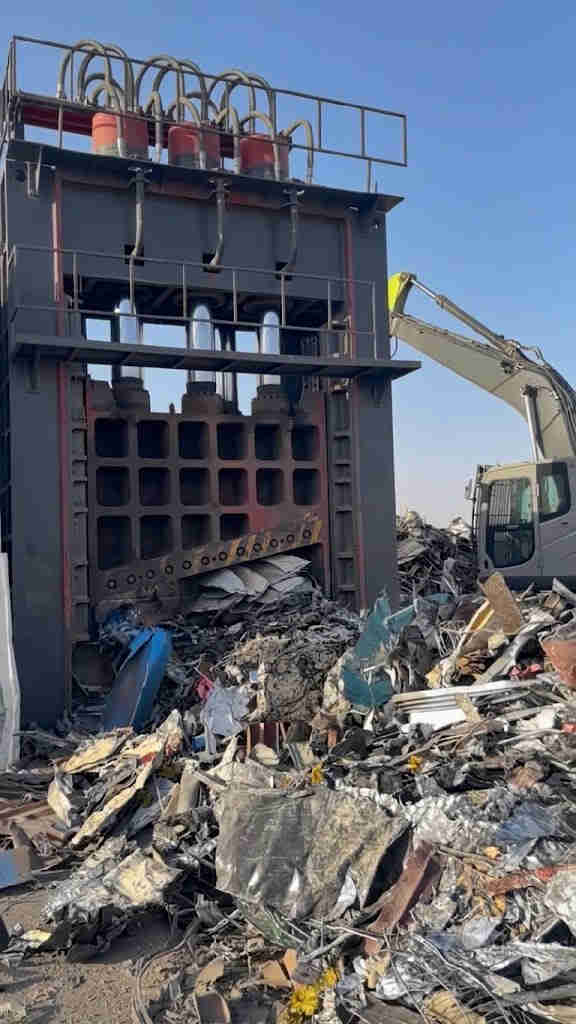
Hydraulic Gantry 1250 Ton Scrap Metal Shear Machine – Q91-1250
The Q91-1250 is a 1250 Ton scrap metal shear for plate-heavy plants running 160–200 tons of sized output per day, with bale cutting specified from this class upward. Heavy-Plate Line: 120 mm plate continuously, 150 mm occasionally. Long Blade: 2,000–2,200 mm for oversized sections. Bales Handled Alongside Heavy Plate: rated for both. Cuts Rebar: loose or bundled, reinforcement still tied into concrete included. Economics Quoted: blade consumption and charge consistency addressed in the quotation, not just force. Matches for large recycling plants, steel mills and furnace-feeding operations CE / ISO 9001 certified. Send your material mix, plate and bale share, and daily volume for a quotation within 48 hours.
Why Choose Huaxin
- Real Factory, 30+ Years Manufacturing Experience
- 24/7 Technical Support
- Customized Solutions Available
- Installation & Training Support
Description
1250 Ton Scrap Metal Shear for Sale – The Heavy-Plate Production Line
The Q91-1250 is a 1250 Ton hydraulic scrap metal shear built for plants whose intake is dominated by heavy plate and oversized sections rather than mixed yard scrap. At 160 to 200 tons of sized output per day, with 2,000–2,200 mm blades and baled-scrap capability from this class upward, it is the tier where a shear stops being a yard machine and starts being a production line component.
Who the Q91-1250 Is Built For
This class is specified by operations with three characteristics:
- Plate-heavy intake: heavy plate and thick sections are the daily norm, not the exception.
- Production-line duty: the machine feeds a furnace or downstream line and its throughput sets the pace of the plant.
- Bale and heavy mixed intake: bales plus oversized sections arrive in the same shift.
Buyers at this tier are usually replacing a 1000-ton machine that is now the plant’s bottleneck, or specifying a new line where the shear capacity was deliberately sized to the furnace rather than to the intake pile.
Why the 1250T Is the Throughput-and-Blade-Life Balance Point
Above the 1000-ton class, every additional ton of force buys plate capability — but it also raises installed power, foundation cost and the energy released on every cut. The 1250 ton class is the point in the range where a plant gets heavy-plate capability without stepping into the infrastructure of a mill-scale installation. For buyers whose economics are driven by blade consumption and charge consistency, that balance matters more than maximum force: the 1000 ton bale-capable class below it handles lighter heavy-section duty well, and the tiers above it are specified for genuinely mill-scale volumes.
Key Specifications – Q91-1250 1250 Ton Gantry Shear
| Item | Specification |
|---|---|
| Model | Q91-1250 Hydraulic Scrap Metal Shear – gantry type |
| Shearing force | 1250 ton |
| Blade length | 2,000 mm or 2,200 mm |
| Motor power | 4×45 kW / 5×45 kW / 6×45 kW |
| Cycle time | 20–35 seconds per cut |
| Daily capacity | 160–200 tons/day, material-dependent |
| Feeding tank length | 7 m / 7.5 m / 8 m |
| Baled scrap capability | Yes — specified from the 1000T class upward |
| Power source | Electric grid, diesel generator, or on-site power station |
| Input voltage | 380V / 400V / 415V / 230V, 50 Hz or 60 Hz |
| Blade material | H13 or M6V tool steel, 56–62 HRC, four-sided reversible |
| Automation | PLC full-auto, remote control, emergency stop, overload protection |
| Certification | CE / ISO 9001 |
| Origin | Tangshan, China |
What the Q91-1250 Cuts – Heavy Plate, Oversized Sections and Bales
Material Duty Ratings
| Material | Q91-1250 duty rating |
|---|---|
| Steel plates | Up to 120 mm continuously; up to 150 mm occasionally |
| Baled scrap | Specified capability — cut to furnace-ready charge size |
| HMS 1 & 2 | Continuous duty |
| H-beams / I-beams | Light through heavy sections, including deformed members |
| Angle and channel steel | Light through heavy structural profiles |
| Steel pipes | Single or bundled, thick-wall included |
| Mixed ferrous scrap | Plate-heavy plant intake including mill returns |
Capability Boundary
- Continuous duty: heavy plate to 120 mm, HMS 1 & 2, oversized sections and baled scrap, all shift long.
- Occasional duty: plate up to 150 mm. Beyond that, size up.
- Step up instead: targets above 200 tons/day, or daily plate above 150 mm, point to the 1600 ton mill-scale class.
Frame, Blades and Heavy-Plate Economics
Heavy plate is unforgiving in a way mixed scrap is not: the cut takes longer to break, the machine absorbs more energy per cycle, and blade edges work harder per ton. The Q91-1250 answers that with a stiffened gantry frame, oversized cylinders specified for sustained heavy loading and a 7 to 8 metre feeding tank that takes oversized members without pre-cutting. Blades are H13 or M6V tool steel at 56–62 HRC, four-sided reversible, and on plate-heavy duty the regrind interval is the number that decides the plant’s consumable cost — so we state it for your mix rather than publishing a figure that fits no real line. Chamber length is configured to your furnace charge requirement.
Applications – Demolition Lines, Plate Stems and Rebar
At 160 to 200 tons of sized output a day, the Q91-1250 is bought for lines whose bottleneck is plate steel and rebar-reinforced demolition material rather than light scrap. It sizes plate stems and structural sections to furnace charge, cuts rebar in bulk, and takes bales alongside — the work a plate-heavy plant refuses to send to a torch.
Rebar-Reinforced Demolition Intake
Demolition contractors and processors feeding this class work material where reinforcing bar is tied into structure: slabs, frames and reinforced sections. The 1250 ton rating puts those sections through at production speed, and the 2,000 to 2,200 mm blade keeps long rebar lengths in one cut rather than three.
Plate Stems and Crop Ends
Fabrication shops and plate mills generate stems and crop ends at uniform thickness and awkward length. Cut to charge size on this machine, that material re-enters the furnace loop the same week — the reason plate-heavy plants settle blade length and chamber length at the order stage, not at commissioning.
Structural Steel and Beam Scrap
Beams, channels and angles out of fabrication and dismantling carry rebar residue, bolts and weldments that stall lighter shears. This class takes deformed members with the reinforcement still attached, so pre-stripping stops sitting on the line as a manual cost.
Furnace Feeding at Mills and Foundries
Where the shear sits directly before a furnace, cut consistency is the specification. Sized charge from one machine — rebar, plate, HMS and bales — keeps furnace loading predictable, and that is what the quotation models: blade life per ton alongside charge uniformity, not force alone.
Shearing Cycle – How the Q91-1250 Works
Material drops into the tank; the side rams clamp and compress against the rear support; the blade descends and sizes the material to the chamber length; sized pieces discharge while the blade returns. Cycle time is 20 to 35 seconds per cut, with heavy plate at the upper end of that band. On plate-heavy duty the reliable figure to model throughput on is the 35-second end, not the optimistic one.
Power Supply, Control and Safety
Motor packages are 4×45 kW, 5×45 kW or 6×45 kW, selected against your intake profile and throughput target, with voltage configured to your switchboard. At this installed power the electrical supply is a civil-works item, not an accessory: we size the supply, cabling and protection against the final configuration before shipment, and we can configure for grid connection, a diesel generator or an on-site power station. Full PLC automation sequences the cycle, remote operation keeps the operator clear of the shear zone, and emergency stop plus overload protection react to abnormal hydraulic conditions.
Shipping, Commissioning and After-Sales
The Q91-1250 ships as separate heavy items — gantry frame and shear head, cylinder packages, hydraulic power unit and electrical cabinet — packed for container or flat-rack sea freight, with a packing list and lifting plan issued against your receiving crane capacity. Foundation drawings, installation drawings and a commissioning checklist come with the machine, and an engineer can attend for start-up and operator training including bale-handling and heavy-plate loading practice. Spares cover blades, seals, valve components and hoses; blade geometry is shared with the rest of the Q91 range, so the plant holds one consumable family rather than several.
Why Plate-Heavy Plants Choose HUAXIN
- The economics are quoted, not just the force. Blade consumption and charge consistency drive the business case at this scale, so both are addressed in the quotation.
- Bale capability included as standard specification from this class upward, with the frame margin to match.
- Chamber length set from your furnace. Charge size is configured to your end-use before the order is cut.
- Manufacturer-direct supply. The machine, the drawings and the service network sit with one factory — no trading company between your plant and the people who welded the frame.
- Power and foundation engineering support. At 4×45 kW and above, the electrical package is designed with your switchboard, not against it.
Choosing Between the Heavy Classes – Q91-1250 vs 1000T vs 1600T
| Item | Q91-1250 (this model) | Q91-1000 | Q91-1600 |
|---|---|---|---|
| Plate, continuous | 120 mm | 100 mm | 150 mm |
| Blade length | 2,000–2,200 mm | 1,800–2,000 mm | 2,400–2,600 mm |
| Motor power | 4×45–6×45 kW | 3×45–4×45 kW | 6×55–8×55 kW |
| Daily capacity | 160–200 t | 100–120 t | 200–240 t |
| Baled scrap | Yes | Yes | Yes |
| Best duty | Plate-heavy line at balanced cost | High-volume mixed intake | Mill-scale three-shift duty |
The honest read on this table: if 100 mm plate and 120 tons/day describe your duty, the 1000 ton class is the more economical machine, and if 150 mm and 240 tons/day describe it, the 1600 ton class is the right one. The 1250 ton scrap metal shear earns its place in the middle of that range, where plate share and blade consumption — not peak force — decide the plant’s economics.
Related Equipment
Plate-heavy plants usually run a mixed intake, and the heavier classes are not the economical answer for the light end of it. Light sheet, profiles and appliance scrap go through a scrap metal shredder instead, with a scrap metal baler behind it for the recovered non-ferrous fraction.
FAQ – 1250 Ton Scrap Metal Shear
What makes the Q91-1250 different from the 1000-ton class?
Plate capability, blade length and throughput. The 1000T is specified at 100 mm plate and 100–120 tons/day; the 1250 ton scrap metal shear runs 120 mm continuous, 160–200 tons/day and 2,000–2,200 mm blades. In practice the difference shows up as blade life on plate-heavy duty and as the difference between feeding a furnace and setting its pace.
Can the Q91-1250 cut baled scrap?
Yes. Bale cutting is specified from the 1000 ton class upward, so bales plus heavy plate and oversized sections are all handled on the same machine. Send your bale specification and the bale share of your intake and we will confirm the configuration.
Is the 1250T right for a plant running three shifts?
It is the class where three-shift operation starts to make sense. At 160–200 tons/day, two-shift running usually covers a plate-heavy plant’s requirement; three-shift operation is more often specified where the shear is feeding a furnace line directly. We model the duty against your actual intake pattern rather than assuming maximum loading.
What plate thickness can the Q91-1250 cut?
Up to 120 mm continuously and up to 150 mm occasionally, alongside continuous HMS and bales. Daily plate above 150 mm or throughput above 200 tons/day points to the 1600 ton class.
How is blade consumption affected by heavy plate duty?
Heavy plate consumes edge faster than mixed ferrous, because each cut works the blade harder per ton of material sized. Blades are four-sided reversible, so each blade gives four working edges, and we state the expected regrind interval for your material mix in the quotation rather than publishing a generic figure.
What data do you need to size a 1250T line?
Material mix with the plate and bale share, heaviest plate or section, target tons per day, number of shifts, feeding method, site power available, and the furnace or end-use. Those points determine blade length, tank length, chamber length, motor package and automation level.
Can the Q91-1250 cut rebar?
Yes — including rebar still tied into concrete from demolition work. Bundled and loose bar is sized in a single pass, and the 120 mm continuous plate rating means reinforced sections stop running as a separate operation ahead of the shear.
What applications is the Q91-1250 used for?
Plate-heavy demolition intake, plate stems and crop ends, structural steel and beam scrap carrying rebar residue, and direct furnace feeding at mills and foundries — with bales handled on the same machine alongside the rest.
Sizing a plate-heavy line? Send your material mix, daily volume and site power details for a configuration recommendation and quotation within 48 hours. Compare the full scrap metal shear range or the 1000 ton bale-capable class.
Additional information
| Machine Type | Hydraulic Scrap Metal Gantry Shear Machine |
|---|---|
| Model No. | Q91-1250 |
| Shearing Force | 1250Ton |
| Material Processed | Light, Medium and Heavy Scrap Metal |
| Application | Scrap Metal Recycling |
| Industry | Scrap Recycling (large-scale) |
| Automation | Full Auto |
| Drive System | Hydraulic |
| Brand | HUAXIN |
| Origin | China |
| Certification | CE ISO9001 |