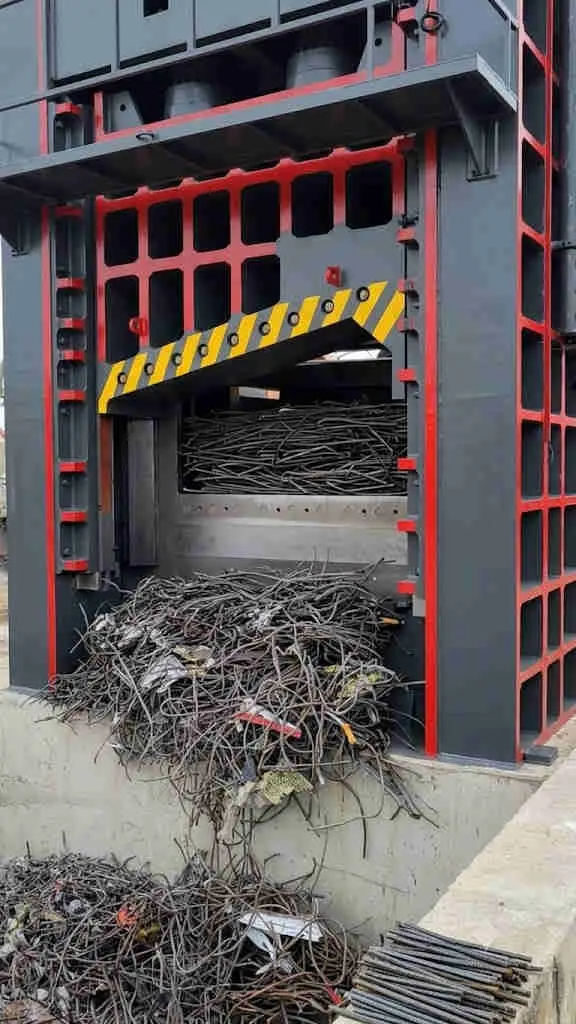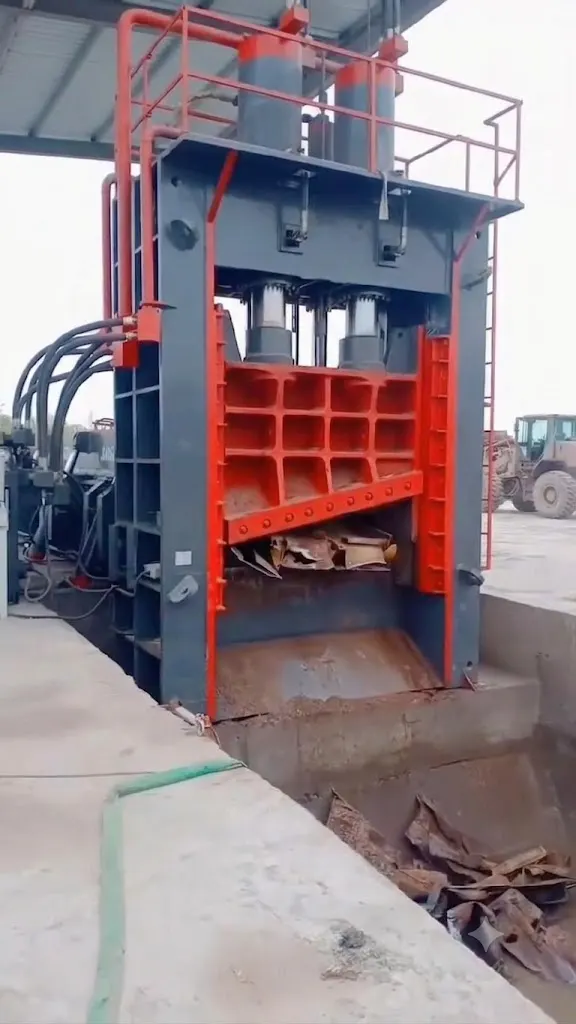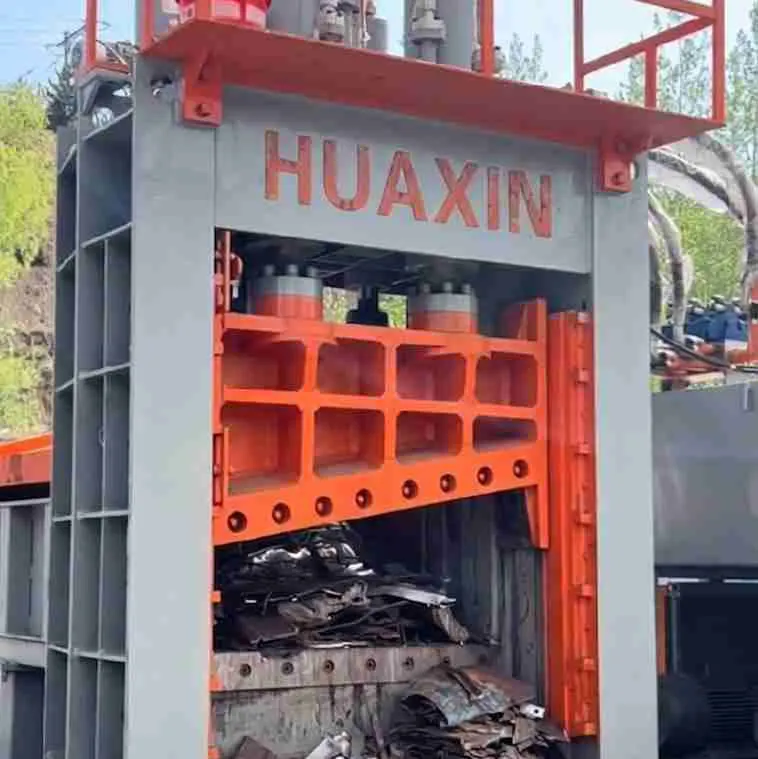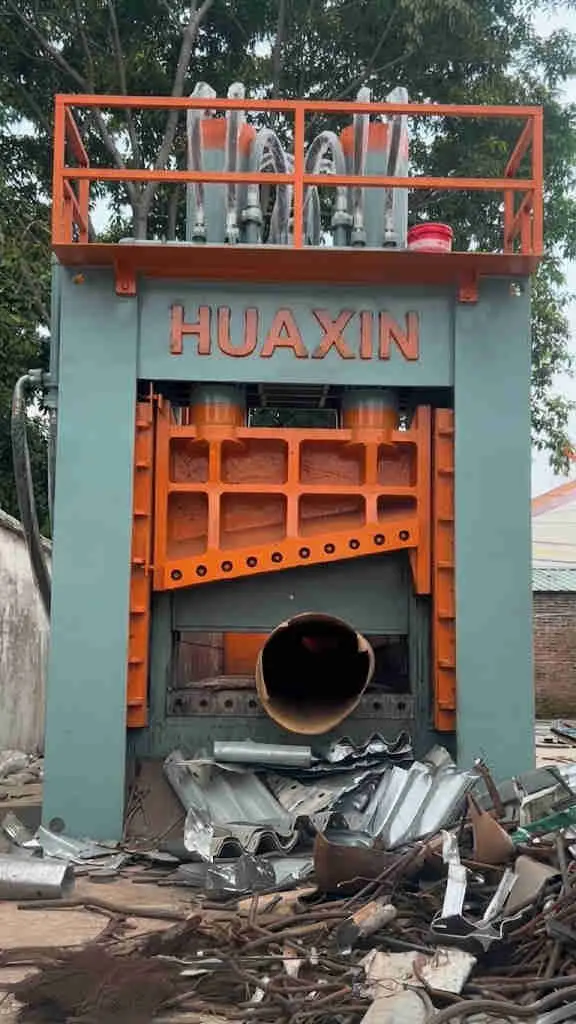
The plain answer to “what is a gantry shear” is this: a stationary hydraulic scrap shear that cuts steel with a vertical blade mounted in a portal-shaped frame. Scrap is loaded into a long horizontal feed box, compressed from the side, clamped, and pushed under the blade one length at a time. HUAXIN builds its hydraulic gantry shear range in Tangshan, Hebei, from 200 t (2,000 kN) up to 2,000 t (20,000 kN) of shearing force.
We have made scrap metal machinery since 1989, at factories in Tangshan and Maanshan, and our machines now work in 30+ countries. This guide explains the machine the way our engineers explain it to a first-time buyer in the Tangshan assembly hall. It covers the parts, one cutting cycle, the tonnage ladder, and where other shear types do the job better.
What Is a Gantry Shear in Plain Engineering Terms
“Gantry” describes the frame. Two heavy uprights and a crossbeam form a portal, like a gate, and the blade slide runs up and down inside it. The lower blade sits fixed in the bed, bolted into a machined seat so the gap between the two blades stays even along the full cutting length. That closed portal is why the design scales to 20,000 kN, where an open jaw would spring apart.
The second defining feature is the feed box, the long horizontal trough where scrap waits to be compressed, clamped and pushed forward. Length: 4 m on our smallest model, 8 m on the largest. A loose pile of rebar, pipe, H-beam or plate offcuts goes into the box from an excavator or grapple crane, and the machine forms it into a dense log before cutting. No one hand-feeds this machine.
The output is cut-to-length steel, typically HMS 1 & 2 and plate-and-structural grades sized for an EAF charging bucket or a foundry. Cut length is set on the PLC, so the same machine can serve two buyers with different length rules.
Main Parts and What Each One Does
Every part below appears on all nine models in our range. Size changes from one tonnage to the next, from a 1,100 mm blade on the smallest frame to 2,800 mm on the largest. The layout does not.
| Part | What it does |
|---|---|
| Gantry frame | Welded, stress-relieved portal that carries the blade slide and takes the full cutting reaction. |
| Feed box | Horizontal trough, 4 to 8 m long by model, that receives scrap from the loader. |
| Side compression | Hydraulic wing or lid that folds in and presses wide or bent pieces inside the blade width. |
| Hold-down | Vertical cylinder that clamps the log against the bed so pieces cannot lift during the stroke. |
| Pusher | Rear cylinder that advances the log by the preset cut length after each stroke. |
| Blades | Upper moving and lower fixed blades in M6V, H13, X45 or D2 tool steel, four usable edges each. |
| Power unit | Electric motors and pumps, from one 22 kW motor up to ten 55 kW motor-pump groups. |
| PLC and remote | Runs the automatic cycle, stores cut lengths, and gives the operator a remote and an emergency stop. |
Buyers often look only at the main cylinder, because its tonnage is the number printed on every brochure and quotation. In our experience the hold-down decides cut quality on light material. If thin bar is not pinned, part of each stroke goes into bending it, and the cut end comes out ragged.
One Cutting Cycle, Step by Step
- The loader drops scrap into the open feed box. On a 200 t machine that is usually a small excavator; at 1,600 t it is a magnet crane or material handler.
- The side compression closes. Loose sections and pipe are squeezed into a log narrow enough for the blade.
- The pusher moves the log forward.
- The hold-down clamps. The main cylinder drives the upper blade down past the lower blade and the piece drops out.
- The blade returns. The pusher indexes the next length.
One stroke takes 20–30 s on the 200 t model and 20–35 s on the others. Heavy plate sits at the slow end of that range, light rebar and thin sections at the fast end, and a mixed load somewhere between the two. Plan your tonnage on that slower figure plus loading time, never on the fastest stroke you see during a factory demonstration.
How Much Force Does a Gantry Shear Need?
Force is the headline number, but buyers choose by the heaviest piece that arrives every week, such as a plate crop or a heavy beam, rather than the rare oversize item. Our range runs in nine classes from 200 t to 2,000 t, and the continuous mild-steel plate limit climbs from 25 mm on the smallest frame to 170 mm on the largest.
Two thresholds matter more than the rest, because they decide whether a yard can accept two whole categories of scrap at all. From 400 t upward the class can take car bodies. From 1,000 t upward it can cut compacted bales, because the hold-down is strong enough to keep a dense block from rolling under the blade.
A small yard cutting rebar and light sections usually starts with a 200 ton gantry shear. A mill-side yard that must open bales and cut 100 mm plate looks at the 1000 ton gantry shear or larger. Plate limits, output and transformer size for all nine classes sit side by side in our gantry shear sizing chart.
What It Cuts, and What to Keep Out
It suits long, stiff and mixed ferrous scrap. That means material too long for a baler chamber, too heavy for a shredder infeed and too slow to cut by torch. Typical feed:
- Rebar, loose or bundled, including demolition cages.
- H-beam, I-beam, angle and channel.
- Steel pipe and casing.
- Plate and plate offcuts, within the continuous limit for the class.
- HMS 1 & 2 from demolition and industrial sources.
- Car bodies on 400 t and larger machines.
- Compacted bales on 1,000 t and larger machines.
- Aluminium and copper sections, with the right blade choice.
Keep out sealed tanks, gas cylinders and anything under pressure, since a closed vessel can burst under side compression long before the blade reaches it. Also keep out plate above the continuous figure for your model as a daily diet. Overloading never cuts faster. It shortens blade life and loads the frame in ways the duty rating was not built for.
How It Compares With Alligator and Container Shears
All three are hydraulic shears. They differ in frame, in how scrap reaches the blade, and in how many tonnes a crew can realistically put through them in a 10-hour day.
| Item | Gantry shear | Alligator shear | Container shear |
|---|---|---|---|
| Frame | Closed portal | Open hinged jaw | Box chamber, often mobile |
| Feeding | Loader into 4–8 m box, automatic pusher | Operator places each piece | Grab into chamber |
| Labour at the blade | One operator on a remote | Operator stands at the jaw | One operator |
| Best fit | Steady daily tonnage, mixed long scrap | Low volume, single bars and pipe | Jobsites and moving work |
An alligator shear costs less. It also caps output, because every cut waits for one person to place one bar in the jaw, line it up and step back before the blade closes. That is slow.
Our alligator shear vs gantry shear guide walks through the switch point. For demolition contractors who move between sites, read container shear vs gantry shear before deciding.
Gantry, Guillotine or Scrap Shear: One Machine, Several Names
Listings from Korea, Europe and North America often call this same machine a guillotine shear, a hydraulic scrap shear or simply a shearing machine. “Guillotine” names the vertical blade action, not the frame. A plate guillotine in a fabrication shop shares that action but not the duty.
Our article on what the hydraulic guillotine shear term covers sorts the vocabulary. Here we stay with the machine itself, because a buyer comparing offers needs to know the frame, the box and the force class far more than the label on the listing.
Frequently Asked Questions
What is a gantry shear used for in a scrap yard?
Cutting long and mixed ferrous scrap, such as rebar, beams, pipe, plate and HMS, into furnace-ready lengths. The PLC sets the cut length, so one yard can supply an EAF and a foundry from the same feed box.
How many people does it take to run one?
One operator on the remote, plus whoever drives the excavator or grapple crane. On many small sites the crane driver and operator are the same person.
Which tonnage should I start with?
Start from your heaviest routine piece and your daily tonnage. If 30 mm plate shows up weekly, a 200 t frame is too light. If you plan to buy bales, the floor is 1,000 t.
Is a gantry shear a fixed or mobile machine?
Our standard range is stationary on a reinforced concrete foundation built to our civil drawings. Electric, generator and diesel drive options let it run at sites without a strong grid.
Send us your scrap mix, daily tonnage and site voltage through our contact page, and the HUAXIN engineering team will return a written quotation within 48 hours.